The post Meeting ICS Cybersecurity Standards With RunSafe appeared first on RunSafe Security.
]]>As software supply chains grow in complexity and ICS devices take on more digital functionality, operators face risk from vulnerabilities buried deep within firmware, dependencies, and proprietary code. Strengthening security and demonstrating compliance begins with improving the integrity, transparency, and resilience of that software.
RunSafe helps industrial organizations achieve this by hardening code against exploitation, increasing visibility into software components through build-time Software Bill of Materials (SBOM) generation, and extending protection to systems that can’t easily be patched or rebuilt.
These capabilities align directly with the technical controls required across major ICS cybersecurity standards, helping operators close gaps in their security posture.
Listen to the Audio Overview
Key ICS Cybersecurity Standards RunSafe Supports
| ICS Standard / Regulation | Relevant Requirements | RunSafe Capability That Supports It |
|---|---|---|
| IEC 62443 (including SR 3.4: Software & Information Integrity) | Software integrity, tamper prevention, secure component management | Protect: Runtime exploit prevention stops unauthorized code execution even when vulnerabilities exist. Identify: Build-time SBOMs document components for integrity verification. |
| NIST 800-82 (Guide to ICS Security) | System integrity (SI), configuration management (CM), continuous monitoring (RA/CA), incident response | Identify: SBOMs support configuration management and vulnerability assessment. Protect: Runtime exploit mitigation enhances system integrity. Monitor: Crash analytics & exploit detection support continuous monitoring. |
| NIST Risk Management Framework (RMF) | Ongoing assessment, vulnerability management, security controls validation | Identify: SBOMs accelerate risk assessment and control verification. Monitor: Evidence and telemetry support ongoing authorization and assessment. |
| NERC CIP | Software integrity, vulnerability assessments, incident reporting, BES Cyber System security | Identify: SBOMs shorten vulnerability assessment cycles. Protect: Hardens embedded systems to maintain operational integrity. Monitor: Provides supporting data for CIP-008 incident response. |
| EU Cyber Resilience Act (CRA) | Mandatory SBOMs, secure-by-design software, vulnerability handling, lifecycle security | Identify: Build-time SBOM generation identifying all components, including for C/C++ builds. Protect: Code hardening reduces exploitability for both known and unknown vulnerabilities. |
| U.S. Federal SBOM Mandates (NTIA, DHS, DoD, FDA) | Accurate, complete, machine-readable SBOMs; traceability; vulnerability identification | Identify: Comprehensive CycloneDX SBOMs generated at build-time that support all mandatory NTIA fields. |
| UK Cybersecurity and Resilience Bill | Supply chain assurance, software integrity, rapid incident reporting | Identify: SBOMs enable supply chain verification and vulnerability tracking. Protect: Code hardening reduces exploitability for both known and unknown vulnerabilities. |
| ISA/IEC 62443-4-1 (Secure Development Lifecycle) | Component inventory, secure build processes, threat mitigation | Identify: SBOM visibility integrated into SDLC and build processes. Protect: Mitigates memory-based vulnerabilities for devices in the field even before patches are available. |
IEC 62443 Security Requirements
IEC 62443 defines security levels (SL-1 to SL-4) to counter cyber threats to ICS systems. Security Requirement 3.4 requires mechanisms to ensure software and information integrity by detecting and preventing unauthorized modifications, which is essential for defending against zero-day exploits.
RunSafe Security supports this with runtime code protection and automated defenses that maintain software trustworthiness in ICS devices, aligning with these IEC 62443 integrity requirements.
NIST 800-82 Control Families
NIST SP 800-82 is a specialized guidance document focused on Industrial Control Systems (ICS) and Operational Technology (OT) environments. It defines 19 control families tailored to these unique contexts, addressing operational, technical, and management controls relevant to ICS security.
RunSafe’s Protect solution assists in meeting NIST standards by hardening software across firmware, applications, and operating systems to reduce vulnerabilities, especially memory-based and zero-day threats. This aligns with minimizing risks outlined in NIST 800-82, such as unauthorized modifications, malware infections, and system exploitation.
NERC CIP standards
NERC CIP applies to bulk electric systems and mandates stringent access control, security monitoring, and incident response to protect critical grid infrastructure.
RunSafe’s automated software hardening strengthens embedded software against vulnerabilities, including zero-day attacks, helping to meet NERC CIP mandates for cybersecurity system management and reducing the attack surface of BES Cyber Systems.
EU Cyber Resilience Act
The EU Cyber Resilience Act imposes mandatory cybersecurity requirements on manufacturers placing products with digital elements into the European market. The regulation requires comprehensive SBOM documentation, vulnerability disclosure processes, and Security by Design principles throughout the product lifecycle.
RunSafe empowers organizations to meet EU CRA requirements through automated build-time SBOM generation, embedded software hardening, and proactive vulnerability identification.
UK’s Cybersecurity and Resilience Bill
The UK’s proposed legislation extends cybersecurity obligations across critical national infrastructure sectors. The bill emphasizes supply chain security and mandates incident reporting within strict timeframes, creating accountability for operators and vendors.
RunSafe Security supports compliance with the UK Cybersecurity and Resilience Bill by providing embedded software security designed specifically for ICS systems and software supply chain transparency through build-time SBOM generation.
How RunSafe Hardens Code & Strengthens the Software Supply Chain to Meet ICS Security Standards
RunSafe improves ICS security posture by providing:
- Build-Time SBOM Generation: Provides complete visibility into software components and software supply chain risk, especially for C/C++ and embedded toolchains.
- Runtime Code Protection: Protects ICS devices in the field, even before patches are available, by preventing the exploitation of memory-based vulnerabilities, including zero-day exploits.
Together, these capabilities directly support key ICS cybersecurity requirements.
The Industrial Control System Software Risk Landscape

ICS cybersecurity risks increasingly stem from software complexity. PLCs, HMIs, sensors, gateways, and controllers rely on layered stacks of compiled code, RTOS kernels, communication libraries, protocol implementations, and third-party components. As this software ecosystem expands, several categories of risk emerge:
1. Vulnerabilities in Proprietary and Third-Party Components
Industrial devices often incorporate dozens or hundreds of software elements, both internally developed and externally sourced. Many of these components lack update mechanisms or clear lifecycle management. When vulnerabilities are disclosed, asset owners frequently lack the visibility needed to determine whether their systems are exposed.
2. Memory Safety Issues as a Persistent ICS Threat
Memory safety remains one of the most common contributors to ICS vulnerabilities. Buffer overflows, use-after-free flaws, and out-of-bounds writes still account for a significant portion of CVEs in industrial and embedded software. These weaknesses persist in critical infrastructure because:
- Many devices use older programming languages (e.g., C/C++)
- Patching may be infeasible due to uptime requirements
- Legacy firmware often cannot be rebuilt or re-verified
- Third-party components introduce memory safety risks through the software supply chain.
Andy Kling, VP of Cybersecurity at Schneider Electric, a major player in the ICS/OT space, found that “memory safety was easily the largest percentage of recorded security issues that we had.” 94% of these weaknesses come from third-party components.
While memory safety is not the only category of ICS risk, it remains one of the most damaging, often enabling remote code execution or multi-stage exploit chains.
3. Software Supply Chain Blind Spots
Software supply chain cyberattacks frequently target the software dependencies and build environments behind industrial products. Without reliable SBOMs, operators cannot:
- Determine which libraries exist in a given binary
- Rapidly assess exposure to new vulnerabilities
- Confidently evaluate vendor-supplied code or firmware
The lack of software transparency turns compliance into guesswork and slows incident response.
4. Operational Constraints That Block Traditional Security Measures
Industrial environments face major deployment challenges:
- Air-gapped or intermittently connected networks
- Decades-old firmware with no vendor support
- Real-time performance requirements that limit scanning or patching
- Multi-vendor PLC fleets with inconsistent update workflows
These realities make it difficult to rely solely on patch management, network segmentation, or perimeter defenses.
5. Physical and Operational Consequences
Because ICS software interacts directly with physical equipment, software vulnerabilities can lead to:
- Manipulation of process parameters
- Shutdown of production lines
- Damage to equipment or the environment
- Safety incidents impacting human operators
Software risk in ICS is therefore both digital and physical, with potentially severe outcomes.
Three Steps to Deploy RunSafe in Existing ICS Security Programs
Given the depth of software risk in modern ICS environments, organizations need solutions that both reduce exploitability and produce the evidence required for rising compliance standards.
RunSafe delivers this by integrating directly into existing development and maintenance workflows, making it possible to improve security posture without operational disruption.
1. Integrate & Automate SBOM Generation at Build Time
Begin by embedding RunSafe’s SBOM generation directly into your CI/CD pipeline or offline build environment. Whether you’re working with embedded Linux, Yocto/Buildroot builds, or legacy RTOS toolchains, RunSafe’s Identify capability produces CycloneDX-compliant SBOMs and supports all mandatory NTIA fields.
You’ll gain full component visibility—down to libraries, files, and versions, including proprietary components—so you can quickly assess exposure, audit supplier code, enforce license policy, and meet SBOM-mandate requirements for ICS environments.
2. Apply Binary Hardening and Runtime Protection
Protecting your software with RunSafe Protect is as easy as installing the packages from our repositories and making a one-line change to your build environment. Once installed, you can automatically integrate Protect into your existing build process.
RunSafe Protect hardens compiled binaries against memory-based exploits and zero-day attacks by applying Load-time Function Randomization (LFR). Even legacy PLC firmware, vendor-supplied binaries, or devices in air-gapped networks can benefit from exploit mitigation. Because the protection works independently of patch status, you’re reducing risk proactively while maintaining operational continuity.
3. Monitor Protected Devices
Deploy RunSafe’s Monitor capability across your hardened device fleet to capture crash indicators, detect unusual behavior patterns, and differentiate between benign failures and potential exploit attempts.
Next Steps to Secure Your ICS Environment
Securing industrial control systems requires more than perimeter defenses or periodic patch cycles. It demands protections that operate inside the software itself—across legacy devices, modern embedded platforms, and complex software supply chains.
RunSafe provides that foundation by hardening binaries against exploitation, generating accurate SBOMs at build time, and delivering operational insight through lightweight monitoring. Together, these capabilities give ICS operators a practical path to strengthen system integrity, reduce exploitability, and demonstrate compliance with the world’s most important cybersecurity standards.
With the right protections applied directly to the software running your critical processes, resilience becomes achievable rather than aspirational.
Request a consultation to get started with RunSafe or to assess your embedded software security and risk reduction opportunities.
FAQs About RunSafe and ICS Compliance
Yes. RunSafe hardens compiled binaries at runtime to let operators secure decades-old PLCs, RTUs, and embedded controllers even when patches are unavailable or unable to be applied.
Does RunSafe impact real-time performance or PLC scan cycles?
RunSafe takes an agentless approach to have very low impact and has been deployed in many resource-constrained environments successfully.
Can RunSafe be deployed in completely air-gapped ICS environments?
Yes. RunSafe supports offline licensing and local-only operations. All analysis, hardening, and SBOM generation can be performed inside secure, disconnected networks. This is particularly valuable for ICS environments with strict isolation requirements or regulatory prohibitions against cloud connectivity.
How does RunSafe help with IEC 62443 SR 3.4 and software integrity requirements?
IEC 62443 SR 3.4 requires mechanisms to prevent unauthorized modification or execution of software components. RunSafe delivers this by making memory-based exploits—including zero days—non-exploitable. Even if a vulnerability exists, exploit attempts fail, helping operators maintain software integrity even on unpatched or legacy systems.
Does RunSafe support NIST 800-82 and NERC CIP incident response and integrity controls?
Yes. RunSafe contributes to several core NIST and NERC CIP requirements:
- System and information integrity: Prevents unauthorized code execution by blocking exploit chains.
- Configuration and vulnerability management: SBOMs accelerate identification of impacted assets.
- Continuous monitoring: Crash analytics and exploit indicators support incident detection and reporting.
This helps operators produce clear, evidence-backed compliance documentation.
How does RunSafe support SBOM requirements in the EU Cyber Resilience Act and U.S. federal mandates?
RunSafe generates build-time SBOMs, capturing every component, including low-level C/C++ libraries and embedded dependencies often missed by scanning tools. RunSafe’s Identify capability produces CycloneDX-compliant SBOMs and supports all mandatory NTIA fields.
Can RunSafe help reduce zero-day exploitability in ICS or embedded software?
Yes. RunSafe’s patented Load-time Function Randomization defends software from memory-based zero days by altering the memory layout of an application each time it runs. This prevents attackers from leveraging memory-based vulnerabilities, such as buffer overflows, to attack a device or gain remote control.
How does RunSafe differ from network-based ICS security tools?
Network tools (IDS, DPI, segmentation) detect or contain attacks, but they cannot prevent exploitation inside the device. RunSafe operates within the software itself, transforming binaries so they cannot be exploited even if the attacker reaches the device or bypasses perimeter defenses. It complements—not replaces—existing ICS security layers by addressing the root of software exploitability.
What types of ICS platforms and RTOS environments does RunSafe support?
RunSafe supports a broad range of ICS platforms, including: VxWorks, QNX, Yocto, Buildroot, Linux, Bare Metal, and more. View a full list of integrations and supported platforms here.
The post Meeting ICS Cybersecurity Standards With RunSafe appeared first on RunSafe Security.
]]>The post Stopping Copyleft: Integrating Software License Compliance & SBOMs appeared first on RunSafe Security.
]]>Embedded engineering teams are aware of the risks and looking for tooling that surfaces license risk early in the development pipeline. RunSafe’s license compliance feature addresses this need by detecting licenses in your code and enforcing your organization’s risk profile to prevent the release of affected code. Teams can ship faster, with the permissions they’ve set, and without risking IP.
Listen to the Audio Overview
Why License Compliance Is Harder for Embedded Systems
Software license compliance means following the legal terms attached to every piece of code in your product, including proprietary, open source, or vendor-supplied. When you ship a device with firmware or deploy a software update, you’re accepting the obligations tied to every component inside.
Embedded teams face unique challenges:
- Heavy static linking: Increases likelihood of triggering copyleft obligations
- Long device lifecycles (10–20 yrs): Mistakes persist for years and can’t be easily fixed
- Mixed vendor + OSS inputs: Hard to track attribution and inheritance
- No package manifests in C/C++: License detection becomes manual and error-prone
How Copyleft Licenses Raise Compliance Stakes

Copyleft is a licensing approach that uses copyright law to keep software open. If you distribute a program containing copyleft-licensed code, you’re typically required to release your modifications—and sometimes related components—under the same copyleft license. That reciprocal obligation separates copyleft from permissive licenses.
If a copyleft license is violated, the potential implications include:
- Mandatory source code disclosure: Courts can order you to release not just the copyleft component but also your modifications, build scripts, and sometimes the proprietary code you linked against.
- Increased risk of exploitation once code is public: Once your source code is released, it makes it easier for malicious actors to analyze and exploit any latent vulnerabilities. Embedded devices are already at risk, the last thing teams want is to accelerate exploit development. (While the goal is to prevent reaching this point through license compliance, if a team finds itself in this situation, RunSafe Protect hardens binaries against exploitation, even when source code is exposed.)
- Legal action and settlements: License holders can seek injunctions to halt product sales, plus damages and legal fees that quickly reach six or seven figures.
- Product recall costs: Fixing a license violation after devices ship may require firmware updates, replacement units, or new packaging with proper notices.
- Reputation damage: In regulated industries like medical devices or defense, license violations signal weak governance and can disqualify you from contracts.
- Supply chain disruption: Customers may freeze orders until you demonstrate compliance, and certification bodies may suspend approvals.
The longer violations exist in shipped products, the more devices are affected and the harder remediation becomes.
How Does Copyleft Happen? A Common Scenario
- A developer adds a library to meet a deadline
- The project statically links against a GPL component
- No manifest exists or an SBOM lacks the detail needed for tooling to flag the risk
- Firmware ships
- A customer, auditor, or regulator requests the SBOM
- Legal discovers the violation, and remediation becomes painful and expensive
Without an accurate SBOM and automated license enforcement, it’s difficult to stop copyleft from entering your codebase. That’s why embedded teams need RunSafe’s file-level SBOMs and license compliance, which surface licenses early and then allow you to block or approve them before release based on your specific risk profile.
How RunSafe Improves License Compliance and Addresses Copyleft Risk
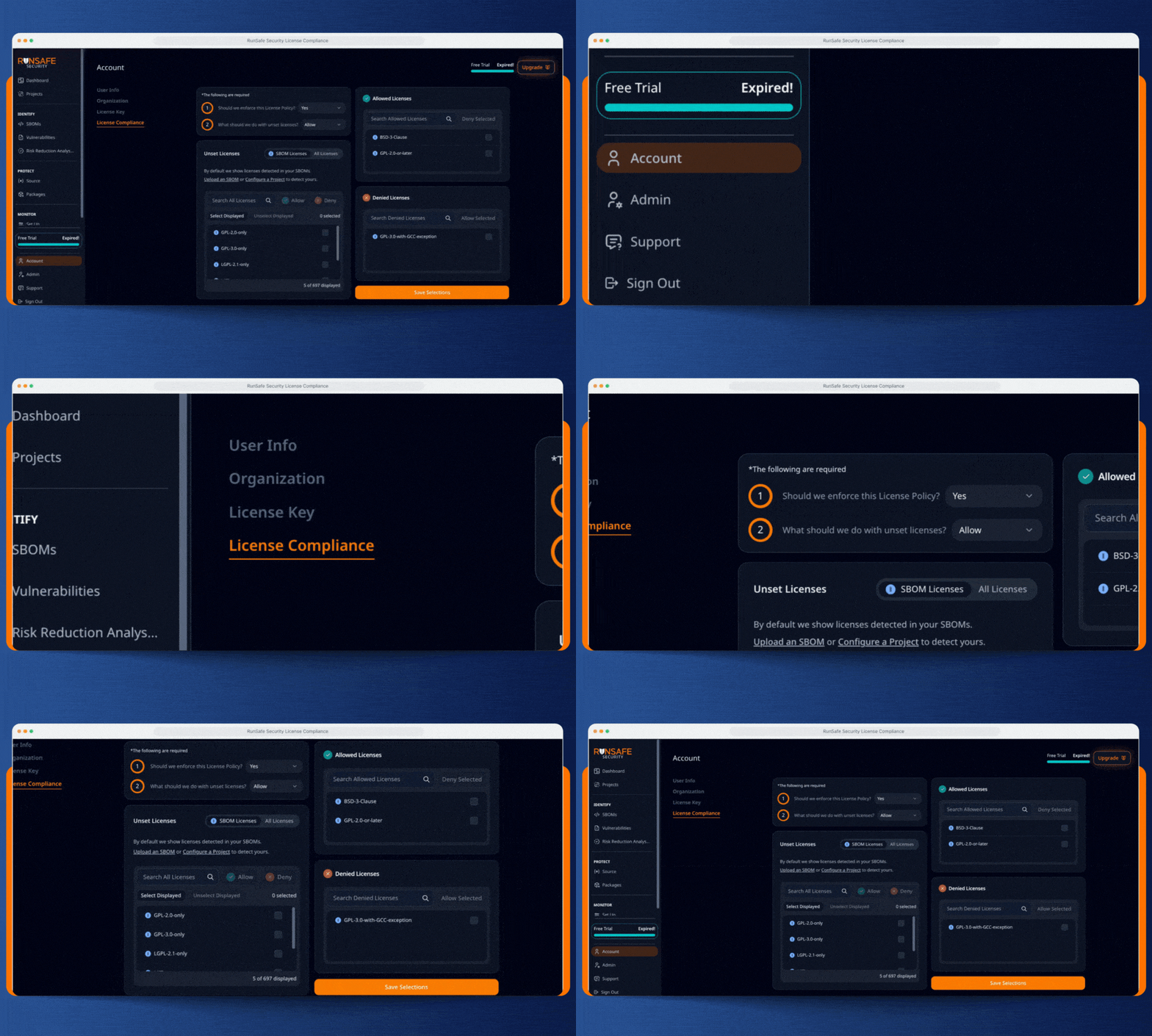
RunSafe’s license compliance feature gives embedded teams control over licenses to prevent violations before code ships. We combine build-time Software Bill of Materials (SBOM) generation with automated policy enforcement to simplify and standardize the process.
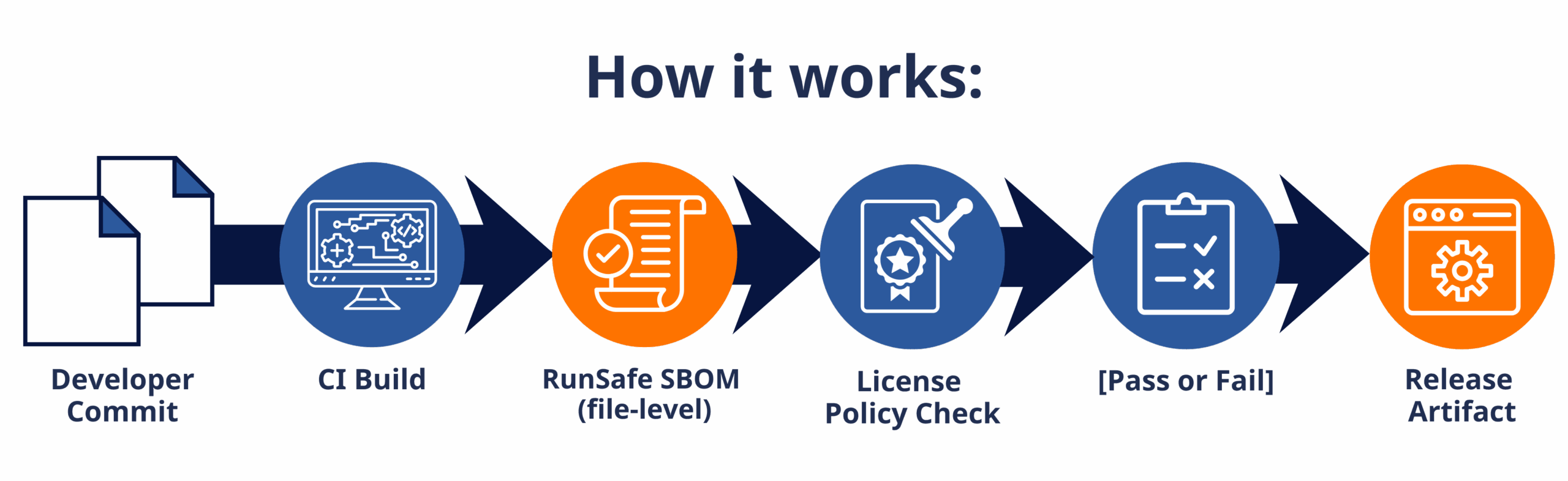
Step 1: Set Your Organization’s License Rules
RunSafe lets you define clear licensing policies across your entire organization, and will be adding support for project-level license compliance to allow for more granularity and flexibility in how you configure your rules. Specify which licenses are approved, which are banned, and which require review. Whether you need to block GPL variants, flag AGPL dependencies, or restrict any copyleft terms, RunSafe allows you to set rules that make sense for your organization.
In the RunSafe Security Platform, you’ll see a list of all the licenses in your software detected by RunSafe’s build-time SBOM generator. You can also view a list of common open-source licenses and choose which to allow or deny. By defaulting to the licenses actually present in your software’s SBOM, your organization can focus on dependencies in use without getting bogged down by unnecessary compliance reviews.
Step 2: Choose Your Enforcement Posture for New Licenses
This is where RunSafe balances control with practicality. For any license you haven’t explicitly classified (unset licenses), you choose one of two approaches:
Allow by default: New dependencies flow through automatically unless they match your explicitly denied list. This keeps development moving while blocking known copyleft risks.
Deny by default: Any unrecognized license halts the pipeline until you review and approve it. This guarded posture ensures maximum protection as your dependencies evolve.
Step 3: Enable Automatic Pipeline Enforcement and Alerts
Once configured, enforcement happens automatically in your CI/CD pipeline. As your CI tool runs your builds, RunSafe generates SBOMs and checks them against your license policy. Pipelines containing denied licenses will fail with clear output in your logs, identifying exactly which licenses triggered the block.
Step 4: Adapt as Your Dependencies Grow
As your team adds new libraries or updates existing ones, newly detected licenses automatically appear in your unset list. Depending on your enforcement posture, they either flow through (if allowed by default) or stop the pipeline for review before releasing code (if denied by default). You can adjust individual license decisions at any time, moving them between allowed and denied as your policy matures.

SBOMs: The Prerequisite for License Enforcement
You can’t enforce license policy if you don’t know what’s in your build. SBOMs solve that, but most SBOM tools fail in C/C++ environments because license data lives in:
- File headers
- Top-level LICENSE files
- Repository metadata
- Vendor drop-ins with no manifest at all
Without file-level SBOM accuracy, compliance becomes guesswork. This is where RunSafe differentiates itself. By generating SBOMs at the file level during build-time, RunSafe can accurately capture license information for embedded projects. This then leads to greater confidence in license compliance.
Protect Your Proprietary Code
By enforcing license policy at build time and pairing it with accurate SBOMs, you can reduce copyleft risk before it reaches production.
Interested in giving it a try? Sign up for a free trial of the RunSafe Security Platform.
FAQs About Copyleft License Compliance
Sometimes, but it depends on the license. LGPL permits dynamic linking with conditions, while GPL remains ambiguous. For embedded systems—which overwhelmingly use static linking—copyleft risk is much higher.
How often should SBOMs be generated?
Every build. Automating SBOM generation ensures accuracy as dependencies change.
What tools can prevent GPL or copyleft code from entering my firmware build?
Look for tools that generate accurate SBOMs at build-time and enforce license policy in the CI/CD pipeline. The most effective solutions automatically flag or block high-risk licenses before code is merged or released. RunSafe provides this capability by combining file-level build-time SBOMs with pipeline enforcement for embedded projects.
How do I automatically enforce open-source license policies in CI/CD?
You need pipeline-level enforcement, not manual reviews. Modern tools can apply license rules (allow, deny, or review) and stop risky code from reaching release or merge. RunSafe integrates directly into your CI/CD pipeline, ensuring that disallowed licenses never reach release branches or production firmware.
How can I detect licenses in C/C++ code when there’s no package manifest?
Most scanners depend on manifests and package metadata, which C/C++ projects often lack. Instead, you need file-level detection that reads license headers and repository artifacts. RunSafe’s build-time SBOM generator does exactly this, making license visibility possible even in C/C++ codebases.
How can I block copyleft without slowing down developers?
Choose a tool that supports both “allow-by-default” and “deny-by-default” modes. That allows developers flexibility for a fast flow in most work and strict control when needed. RunSafe supports both, so teams can balance velocity and risk.
How can I automate GPL license compliance for firmware?
Automation requires two layers: (1) license detection via build-time SBOMs, and (2) policy enforcement in CI/CD. When these steps are automated, teams avoid manual review and prevent GPL from slipping into release artifacts. RunSafe delivers both in a single workflow.
How do I enforce open-source license rules in GitHub or GitLab CI?
Use a tool that integrates into your CI/CD pipeline and can block merges or releases based on your set license policies. RunSafe ties directly into GitHub and GitLab CI pipelines so enforcement happens automatically with each build.
The post Stopping Copyleft: Integrating Software License Compliance & SBOMs appeared first on RunSafe Security.
]]>The post Beyond Patching: How to Secure Medical Devices and Meet FDA Compliance Without Changing Code appeared first on RunSafe Security.
]]>Key Takeaways:
- Legacy devices can’t be patched easily, but compensating controls provide alternatives.
- SBOMs are critical for transparency and accountability.
- The FDA now mandates secure development and life cycle planning.
- Cybersecurity and patient safety are inseparable—breaches harm care.
- Collaboration is the only sustainable path forward.
In healthcare cybersecurity, one of the biggest challenges is protecting medical devices that are difficult to patch and written in memory unsafe languages. Unlike web applications or mobile software, which can be updated overnight, medical devices are often built to last 10–15 years and aredesigned for reliability and patient safety—not constant code revisions.
Yet cyber threats are growing, and FDA regulations are tightening. Manufacturers and healthcare providers are now under pressure to secure legacy systems while keeping patients safe. The question is: how can this be done without rewriting a single line of code?
This was the focus of a recent episode of Exploited: The Cyber Truth, featuring Phil Englert (VP of Medical Device Security at Health-ISAC) and Joseph M. Saunders (Founder & CEO of RunSafe Security). Their insights offer a practical roadmap that blends compensating controls, regulatory awareness, and industry collaboration.
The Reality of Legacy Devices: Built to Last, Hard to Secure
Medical devices weren’t designed with today’s cybersecurity challenges in mind. Hospitals rely on equipment that often stays in service for a decade or more, from MRI machines to pacemakers, because replacing them isn’t financially or operationally feasible. These devices also run on limited computing resources and cannot tolerate downtime, making traditional patching nearly impossible.
As Englert explained, “We’ve painted a target on our back” by connecting these devices to networks for efficiency and data sharing but without always providing the necessary safeguards. That combination of longevity, limited resources, and operational necessity makes securing these devices a unique and ongoing challenge.
Security Without Code Changes: What It Really Means
When patching or rewriting isn’t an option, the focus shifts to compensating controls, or ways to secure devices without touching their software, as well as opportunities for code protection.
- Monitoring: Establishing real-time visibility into device activity to catch anomalies early.
- Segmentation: Isolating devices so that a breach doesn’t cascade across the network.
- Code Protection: Secure embedded devices in real-time to prevent attacks.
These approaches are not one-size-fits-all. The strategy for an implanted pacemaker is very different from that for a helium-filled MRI machine. But the principle remains: if you can’t harden the device itself, you must harden its environment.
SBOMs: Building Trust Through Transparency
Another theme from the discussion was the rise of Software Bills of Materials (SBOMs). Much like a nutrition label on food, SBOMs give visibility into the “ingredients” inside a medical device. This transparency allows healthcare providers to quickly assess whether known vulnerabilities, like Log4j, impact their devices, hold manufacturers accountable, and make smarter, risk-based decisions about deployment.
As Saunders noted, SBOMs are most valuable when generated close to the point of software production, ensuring accuracy and reliability.
FDA Compliance: Guidance Becomes Mandate
For years, FDA cybersecurity guidance was considered “best practice.” That changed in December 2022 when Congress gave the FDA statutory authority over device cybersecurity under the PATCH Act. By March 2023, manufacturers were required to follow a secure software development lifecycle, account for the full environment in which devices operate, and maintain controls and documentation throughout the device’s lifespan.
This represents a major shift. Compliance is now enforceable, and the focus has expanded from protecting data to ensuring patient safety across interconnected healthcare ecosystems.
Why Patient Safety Is the True Bottom Line
Cybersecurity lapses aren’t abstract IT problems—they have real consequences for patient outcomes. Studies show that clinical performance can decline for up to 18 months following a hospital breach, as resources are diverted to recovery efforts. The “blast radius” often extends beyond one hospital, affecting neighboring facilities that absorb overflow patients.
Among organizations that experienced cybersecurity incidents affecting medical devices, 75% said that cyber incidents caused at least a moderate patient care impact. 46% required manual processes to maintain operations and 24% required patient transfers to other facilities.
As Saunders emphasized, “Cybersecurity is an enabler of patient safety.” Even the most advanced medical care can be undermined without strong cybersecurity practices in place.
Collaboration: The Missing Piece
Perhaps the most actionable takeaway is that no single organization can address these challenges alone. Manufacturers, healthcare providers, regulators, and third-party service organizations all have roles to play.
Practical steps include:
- Negotiating stronger controls before adopting new devices.
- Sharing information through groups like Health-ISAC.
- Starting small—building inventories, mapping data flows, and tightening controls incrementally.
Englert summed it up best: “80% of anything is better than 100% of nothing. Start where you can with the resources you have.”
For more insights on medical device cybersecurity, download RunSafe’s 2025 Medical Device Cybersecurity Index.
The post Beyond Patching: How to Secure Medical Devices and Meet FDA Compliance Without Changing Code appeared first on RunSafe Security.
]]>The post The 2025 SBOM Minimum Elements: A Turning Point But Embedded Systems Still Risk Being Left Behind appeared first on RunSafe Security.
]]>Key Takeaways
- The 2025 SBOM minimum elements represent significant progress since the 2021 baseline.
- New fields, such as license, hashes, and generation context, push SBOMs beyond check-the-box compliance.
- Licensing data closes a critical blind spot in software supply chain risk management.
- Generation context highlights build-time SBOMs as the industry gold standard.
- Embedded software remains at risk of being overlooked unless file-level SBOMs are explicitly recognized.
In August 2025, the Cybersecurity and Infrastructure Security Agency (CISA) and the Department of Homeland Security (DHS) released a new draft of the Minimum Elements for a Software Bill of Materials (SBOM). It’s the first major revision since 2021, when the National Telecommunications and Information Administration (NTIA) outlined a simple baseline of just seven fields.
The new draft is a genuine turning point. It raises the bar for SBOMs, pushing them beyond check-the-box compliance and closer to being a real tool for managing risk. But while these changes are a big step forward, they still leave embedded systems—built largely in C and C++—struggling to fit into a framework designed with modern package-managed software in mind.
As Kelli Schwalm, SBOM Director at RunSafe Security, puts it: “The recommended 2025 SBOM minimum elements show how far the industry has come since 2021. We’ve moved from a theoretical checklist to practical requirements that reflect how SBOMs are actually used in the real world.”
However, Kelli warns, the implicit assumption in the draft recommendations is that a software component equals a package. For embedded systems, that’s not the case. Without explicit recognition of file-based SBOMs, we risk leaving critical systems out of the picture.
Listen to the Audio Overview
What Are SBOM Minimum Elements?
An SBOM is an ingredients list for software. To be useful, every SBOM must include certain key data fields, or the minimum elements.
In 2021, the NTIA’s list was a good starting point, but as software development has evolved, it is now far too basic: name, version, identifier, timestamp.
To reflect the reality of software development today, the 2025 draft adds fields like:
- License: Critical for compliance and security obligations
- Component hash: Cryptographic accuracy, pushing toward automation
- Generation context: Identifying whether an SBOM was created at source, build, or binary stage
- Dependency relationships: Clarifying how components connect
The updates reflect how organizations are actually using SBOMs today to manage software supply chain risk.
Why the New SBOM Minimum Elements Guidance Matters
From “Check-the-Box” to Automation
The 2021 requirements made it possible to deliver a barebones SBOM with nothing more than an Excel spreadsheet. Those quickly went stale and carried little value. The new requirements—particularly hashes, license data, and generation context—make that shortcut nearly impossible, forcing a move toward automated SBOM generation.
As Kelli explained: “By requiring more fields—hashes, authorship, generation context—CISA is making it almost impossible to get by with an outdated Excel spreadsheet. These new elements push the industry toward automated, accurate SBOM generation, which is the only way to keep pace with today’s threat environment.”
Licensing Finally Gets Its Due
License information is now a minimum requirement. Licensing is a compliance issue, but license restrictions can directly impact how software can be used or redistributed. By including it, CISA and DHS are addressing a real-world gap that often goes unnoticed until it becomes a legal or operational problem.
“Licensing impacts how organizations use and share software,” Kelli said. “Ignoring it in SBOMs left a blind spot in the software supply chain, and closing that gap is long overdue.”
Generation Context Raises the Quality Bar
Including generation context—stating where in the lifecycle the SBOM was created—is a small addition with outsized impact. For example, “Build-time SBOMs give the clearest and most accurate view of software,” Kelli said. “This requirement could pressure suppliers to deliver them, raising the quality bar across the ecosystem.”
By making generation context mandatory, the draft puts pressure on suppliers to produce higher-quality SBOMs and discourages binary-only or “black box” approaches.
Compare SBOM generation approaches.
RunSafe’s Perspective
RunSafe sees the 2025 SBOM minimum elements as a much-needed course correction. They reflect four years of learning, discourage paper-thin compliance practices, and push the industry toward automated, accurate, and timely SBOMs.
But gaps remain, especially for embedded systems. Most federal guidance still implicitly equates “software component” with “package.” For modern applications built with package managers, that’s fine. For embedded devices, it’s a problem.
“Most federal guidance still assumes software components come neatly packaged, but embedded software in C and C++ rarely works that way,” Kelli said. “File-level SBOMs are harder to generate, but they’re also where you get the most precise vulnerability data.”
That precision matters most in embedded systems—the software inside medical devices, critical infrastructure, and defense technology—where false positives waste time and false negatives risk lives.
“If we don’t account for embedded use cases, we risk leaving out some of the most critical systems,” Kelii said.
RunSafe believes the draft’s generalized fields are a step in the right direction, but federal guidance should go further. It should explicitly recognize that SBOMs can be generated at the file level, not just at the package level, and that embedded contexts demand this granularity.
Raising the Bar for Software Supply Chain Security
The 2025 SBOM minimum elements draft is a milestone. It raises expectations, improves accuracy, and pressures suppliers to move beyond token compliance. That’s progress.
But for SBOMs to fulfill their promise across the entire software ecosystem, we must ensure embedded systems are not left behind. File-level SBOMs are essential for securing the most critical software our society relies on.
At RunSafe, we applaud the direction of the new guidance and will continue to advocate for embedded-first thinking in SBOM guidance. The security of the software supply chain depends on it.
Learn more about RunSafe’s approach to SBOM generation and software supply chain security. Download our white paper or view our SBOM tool comparison.
The post The 2025 SBOM Minimum Elements: A Turning Point But Embedded Systems Still Risk Being Left Behind appeared first on RunSafe Security.
]]>The post What Product Leaders Need to Know About EU CRA, FDA, and Cyber Regulations appeared first on RunSafe Security.
]]>The regulatory landscape for product security has fundamentally shifted. What was once a “nice-to-have” consideration has become mandatory compliance across industries, with cybersecurity now sitting at the center of product development, risk management, and go-to-market strategies.
Product leaders today face mounting pressure from multiple regulations—the EU Cyber Resilience Act (CRA), FDA cybersecurity requirements, and a growing list of industry-specific mandates—while still needing to maintain innovation speed and profitability. The stakes couldn’t be higher: non-compliance risks include fines up to €15 million or 2.5% of global turnover under the CRA, market access restrictions, and potentially devastating reputational damage.
But here’s the critical insight that forward-thinking product leaders are discovering: these regulations don’t have to be a burden. When approached strategically, regulatory compliance can become a competitive differentiator that strengthens products, builds customer trust, and creates sustainable business advantages.
Listen to the Audio Overview
The Product Compliance Tidal Wave: Understanding the Forces at Play
The 2024-2025 period has seen new cybersecurity regulations appear across sectors, representing a fundamental shift in how responsibility for product security is assigned and enforced.
The most significant change is the shift in liability. Under traditional models, end users often bore responsibility for securing the products they purchased. Today’s regulations flip this dynamic, making manufacturers the primary guardians of product security throughout the entire lifecycle. The CRA rebalances responsibility toward manufacturers and sets new standards across product lifecycles, fundamentally changing how companies must approach product development and support.
Supply chain transparency has become another critical factor. New requirements for Software Bills of Materials (SBOMs) and vulnerability disclosure mean that product leaders can no longer treat their supply chains as black boxes. Every component, every dependency, and every potential vulnerability must be catalogued, monitored, and managed.
As RunSafe Founder and CEO Joe Saunders has emphasized, “If a vendor can’t tell you what’s in their product, chances are, they don’t know either.” This lack of knowledge will no longer fly with consumers, regulators, or internal risk management teams.
Perhaps most importantly, these regulations demand a cultural transformation within organizations. As noted by cybersecurity experts at IMD Business School in a June 2025 Qt Group analysis, “the EU Cyber Resilience Act demands a fundamental cultural and leadership shift in organizations,” moving away from security as a bolt-on feature to security as a foundational element of product design.
The EU Cyber Resilience Act: A New Paradigm for Product Security
The CRA represents the most comprehensive product security regulation to date, with implications that extend far beyond European borders. Understanding its requirements isn’t just about compliance, it’s about understanding where the entire industry is heading.
Timeline and Strategic Implications
The CRA entered into force on December 10, 2024, but the most critical date for product leaders is December 11, 2027, when most obligations become enforceable. This timeline creates both urgency and opportunity: companies that start preparing now will have significant advantages over competitors who wait until the last minute.
The regulation’s scope is deliberately broad, covering all connected products and software sold in the EU, regardless of where the manufacturer is located. This means that any company selling digital products globally needs to consider CRA compliance as a baseline requirement.
Core Requirements That Change Everything
The CRA’s “Secure-by-Design” mandate isn’t just regulatory language but a complete shift in how products must be conceived, developed, and maintained. Security can no longer be retrofitted; it must be integral from the earliest design phases.
Vulnerability management under the CRA requires manufacturers to report vulnerabilities within 24 hours of discovery and implement coordinated disclosure processes. This creates new operational requirements but also opportunities for companies that excel at rapid response and transparent communication.
The documentation requirements are extensive, covering security documentation, risk assessments, and conformity declarations. While this creates an administrative burden, it also forces companies to develop more rigorous security practices that typically result in higher-quality, more resilient products.
Post-market obligations represent perhaps the biggest shift, requiring ongoing security updates for a minimum of five years or the expected product lifetime. This transforms the economics of product development, making long-term security support a core business consideration rather than an afterthought.
FDA Cybersecurity Requirements: Medical Devices Lead the Way
The FDA’s 2025 cybersecurity guidance updates represent a maturation of medical device security requirements, but their implications extend beyond healthcare. As one of the most regulated industries, medical devices often preview compliance approaches that eventually spread to other sectors.
The New Enforcement Reality
The FDA’s latest guidance mandates that cybersecurity must be demonstrated from pre-market design through post-market support, with strong documentation on vulnerabilities and supply chain transparency for all device components. This lifecycle approach mirrors the CRA’s philosophy and suggests a convergence toward comprehensive product security requirements across industries.
The emphasis on SBOM requirements for connected medical devices creates new transparency obligations but also opportunities for companies that can demonstrate superior supply chain security. Companies that proactively implement robust component tracking and vulnerability management will find themselves better positioned for both regulatory compliance and customer trust.
Strategic Impact on Product Development
The FDA’s approach changes go-to-market strategies for medical technology companies. Security documentation is now part of the regulatory submission process, meaning that security considerations must be built into product development timelines from the beginning.
This creates new resource allocation challenges, as companies need dedicated cybersecurity expertise within product teams. However, it also creates competitive advantages for companies that develop this expertise early and can demonstrate superior security practices to customers and regulators.
Learn more about navigating vulnerability identification and postmarket cybersecurity for medical devices in this video: On-Demand Webinar: Medical Device Cybersecurity Challenges
Strategic Focus Areas: Maximizing ROI on Security Investments
With limited resources and expanding regulatory requirements, product leaders must prioritize their security investments strategically. The most successful companies focus on areas that provide both regulatory compliance and business value.
Supply Chain Security and SBOM Management
SBOM requirements appear across multiple regulations—the CRA, FDA guidance, and emerging requirements in other sectors. This makes supply chain transparency a high-leverage investment that addresses multiple compliance requirements simultaneously.
The business case extends beyond compliance. Companies with comprehensive SBOM capabilities can respond faster to supply chain vulnerabilities, reduce incident response costs, and demonstrate superior risk management to customers and partners. The key is implementing automated SBOM generation and continuous component monitoring rather than treating it as a one-time documentation exercise.
Vulnerability Management Excellence
Both the CRA’s 24-hour reporting requirement and the FDA’s lifecycle security obligations demand sophisticated vulnerability management capabilities. Companies that excel in this area gain competitive advantages that extend far beyond compliance.
Proactive vulnerability management reduces breach costs significantly—studies show comprehensive vulnerability management programs can reduce incident costs by millions of dollars. Research indicates that the average cost of a data breach reached $4.88 million in 2024, according to IBM’s Cost of a Data Breach Report. More importantly, companies known for rapid, transparent vulnerability response build trust with customers and partners that translates into business growth.
The implementation challenge is building systems that can automatically detect, assess, and respond to vulnerabilities across complex product portfolios. This requires integration between threat intelligence, asset management, and incident response processes.
Secure Development as Competitive Advantage
The CRA’s Secure-by-Design requirements and the FDA’s lifecycle approach both emphasize building security into products from the ground up. Companies that master secure development practices don’t just achieve compliance—they build products that customers trust and competitors struggle to match.
Key elements include integrated threat modeling, secure coding standards, and security testing throughout the development lifecycle. The goal isn’t just to pass security audits but to build products that are inherently more resilient and trustworthy.
The Benefits of Proactive Product Compliance
The most successful product leaders are discovering that proactive product compliance creates business value that far exceeds the investment required.
Competitive Differentiation Through Security
In increasingly security-conscious markets, products with built-in security capabilities command premium pricing and win more procurement decisions. This trend is particularly pronounced in healthcare, where RunSafe Security’s 2025 Medical Device Cybersecurity Index found that 60% of healthcare organizations prioritize built-in cybersecurity protections when selecting vendors, with 79% willing to pay a premium for devices with advanced runtime protection.
Security-first product positioning also builds long-term customer relationships. Companies that can demonstrate transparent security practices and rapid vulnerability response develop customer loyalty that extends beyond individual product transactions.
Operational Excellence and Risk Reduction
Secure-by-Design development practices reduce technical debt by preventing security issues rather than retrofitting solutions. This approach typically results in lower long-term development and maintenance costs, even accounting for upfront security investments.
Good security practices also streamline regulatory audits and compliance verification. Companies with mature security programs spend less time and resources on compliance activities because their standard practices already meet or exceed regulatory requirements.
Financial Returns and Investment Attraction
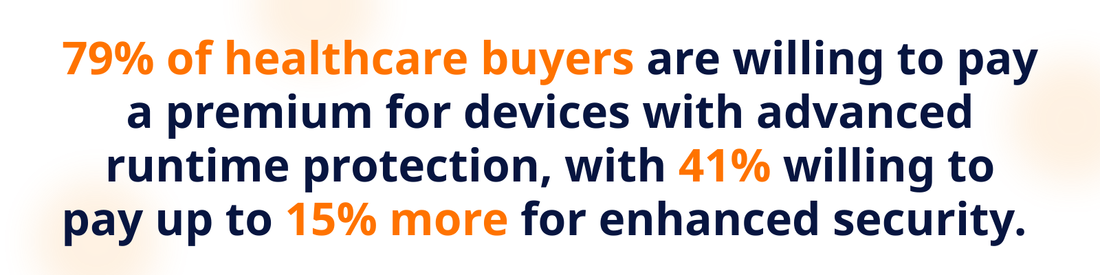
The financial benefits of proactive security extend beyond cost reduction. Healthcare organizations demonstrate this market reality clearly, as seen in RunSafe’s 2025 Medical Device Cybersecurity Index. 79% of healthcare buyers are willing to pay a premium for devices with advanced runtime protection, with 41% willing to pay up to 15% more for enhanced security. Additionally, 83% of healthcare organizations now integrate cybersecurity standards directly into their RFPs, while 46% have declined to purchase medical devices due to cybersecurity concerns.
Risk reduction creates additional financial value through lower incident response costs, reduced legal exposure, and improved cyber insurance rates. Companies with strong security programs often achieve significantly lower insurance premiums and better coverage terms. The documented financial impact of attacks like WannaCry, which cost the NHS £92 million, demonstrates that prevention is far more cost-effective than recovery.
What’s Next: Preparing for the Evolving Landscape
The regulatory landscape will continue to evolve, with several emerging trends that product leaders should monitor and prepare for.
- AI and machine learning governance represent the next frontier of product regulation. As AI capabilities become embedded in more products, expect new requirements for AI security, transparency, and accountability.
- Quantum-safe cryptography is another emerging area. As quantum computing capabilities advance, current cryptographic standards will become vulnerable, creating new requirements for post-quantum security measures.
- Cross-border data flow regulations continue to evolve, with new privacy and data localization requirements affecting how products handle and store user data.
Strategic Recommendations for Product Leaders
Based on the regulatory trends and business opportunities outlined above, several strategic recommendations emerge for product leaders navigating this complex landscape:
1. Invest heavily in automation capabilities
Manual compliance processes are unsustainable given the complexity and pace of regulatory change. Companies that build automated compliance capabilities will have significant advantages over competitors still relying on manual processes for monitoring, reporting, and verification.
2. Build strategic security partnerships
Few companies have all the expertise needed to excel across the full spectrum of security and compliance requirements. Strategic partnerships with specialized security vendors can provide access to expertise and capabilities that would be expensive to develop internally while accelerating time-to-market for compliant products.
3. Focus on security solutions that eliminate entire vulnerability classes
Rather than playing defense against individual threats, prioritize technologies that can eliminate broad categories of vulnerabilities. Runtime protection solutions that prevent exploitation at the device level represent this approach—they provide comprehensive protection without requiring constant updates or patches. This strategy significantly reduces risk while simplifying compliance management across product portfolios.
4. Stay informed about regulatory developments through structured processes
The regulatory landscape continues to evolve rapidly, and companies that can anticipate changes rather than just react to them will maintain competitive advantages. Establish dedicated resources for monitoring regulatory trends and translating them into product development requirements.
5. Design for global compliance standards from the start
Rather than building separate compliance programs for different markets, design for the most stringent requirements across all target markets. This approach reduces complexity while ensuring products can be sold in any market without additional compliance engineering.
Product Compliance as a Competitive Advantage
The convergence of the EU Cyber Resilience Act, FDA cybersecurity requirements, and other emerging regulations represents both the greatest challenge and the greatest opportunity facing product leaders today. The companies that view these requirements as innovation drivers rather than compliance burdens will build more secure, resilient, and successful products.
The critical insight is that waiting is not a viable strategy. The December 2027 CRA deadline and evolving FDA requirements create urgency, but companies that start building security capabilities now will discover that the benefits extend far beyond regulatory compliance.
For product leaders ready to turn cybersecurity compliance into a competitive advantage, the path forward is clear: embrace security as a core product differentiator, invest in the capabilities needed to excel at both security and compliance, and build the partnerships needed to stay ahead. The companies that make these investments today will be the market leaders of tomorrow.
Learn more about how to safeguard your code to up your product compliance. Get the white paper: “Safeguarding Code: A Comprehensive Guide to Addressing the Memory Safety Crisis.”
The post What Product Leaders Need to Know About EU CRA, FDA, and Cyber Regulations appeared first on RunSafe Security.
]]>The post What Healthcare Buyers Expect from Medical Device Manufacturers: Security Is No Longer Negotiable appeared first on RunSafe Security.
]]>The consequences reach beyond network disruptions: 75% of these incidents directly compromised patient care, with nearly half compelling organizations to revert to manual processes just to maintain operations. When a cyberattack necessitates transferring patients to other facilities, which occurred in 24% of cases, the situation creates serious medical emergencies.
The convergence of IT and OT security is putting medical devices at the center of cybersecurity strategy, the report shows. Healthcare organizations can no longer protect medical devices in isolation. Securing patient-critical systems now requires defending the entire interconnected ecosystem.
Because of this, we’re seeing a changing relationship between healthcare providers and medical device manufacturers. The findings of the 2025 Index show that for healthcare buyers, cybersecurity is becoming a gatekeeper to market access.
Medical Device Cybersecurity: From Nice-to-Have to Must-Have
Healthcare buyers have spoken with their wallets and their purchasing decisions. The data reveals a dramatic transformation in how medical devices are evaluated and purchased:
- 83% of healthcare organizations now integrate cybersecurity standards directly into their RFPs
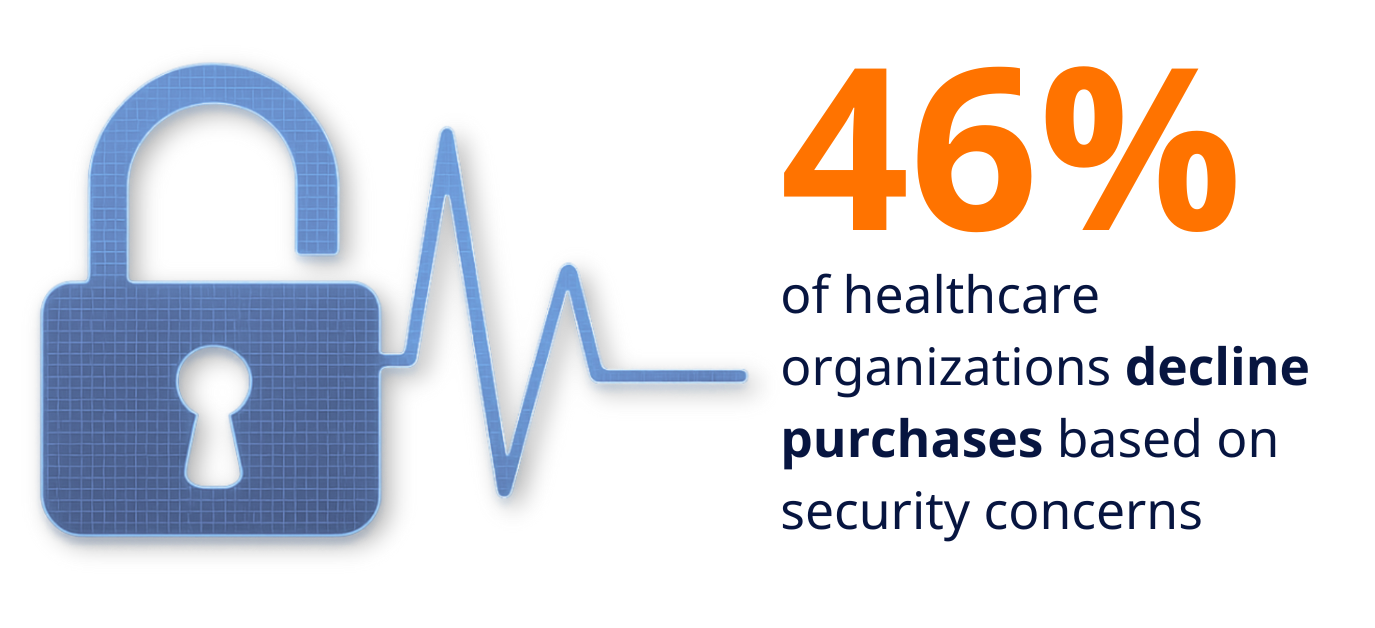
- 46% have declined to purchase medical devices due to cybersecurity concerns
- 79% are willing to pay a premium for devices with advanced runtime protection
When nearly half of potential buyers are prepared to walk away from purchases over security issues, manufacturers can no longer treat cybersecurity as an afterthought. This willingness to reject products represents a fundamental shift from traditional procurement practices where functionality and cost dominated decision-making.
Healthcare leaders have moved from asking “What can this device do?” to “How secure is this device?” The organizations that have experienced attacks understand that the most feature-rich device in the world can become a liability if it is not secure.
The Trust Equation Has Changed
The ripple effects extend beyond individual purchasing decisions. Nearly a third (32%) of healthcare organizations report that security incidents have affected their trust in specific vendors, requiring additional security verification from previously trusted partners.
Those manufacturers must now prove their security credentials to maintain existing relationships, not just win new ones. Healthcare organizations are conducting security audits of their entire vendor ecosystem, reassessing partnerships through the lens of cybersecurity risk rather than traditional performance metrics.
What Healthcare Leaders Want: Transparency and Built-In Defense
The survey data reveals clear expectations from healthcare buyers. They are not asking for band-aid solutions but want security baked into the device’s DNA from day one.
1. Software Bills of Materials (SBOMs) Are Non-Negotiable
78% of organizations consider SBOMs essential or important in procurement decisions. This extends beyond regulatory compliance to practical vulnerability management. The FDA now requires SBOMs in premarket submissions, and healthcare buyers understand that knowing device components constitutes fundamental ongoing security. Transparency becomes a competitive necessity.
However, generating comprehensive and accurate SBOMs remains challenging for many embedded medical devices written in C/C++. Traditional binary analysis SBOM solutions often produce excessive false positives and overlook critical components, such as static libraries. Healthcare organizations increasingly seek vendors who can provide build-time SBOM solutions that accurately capture only the components present in the final device.
2. Built-In Security Over Bolt-On Solutions
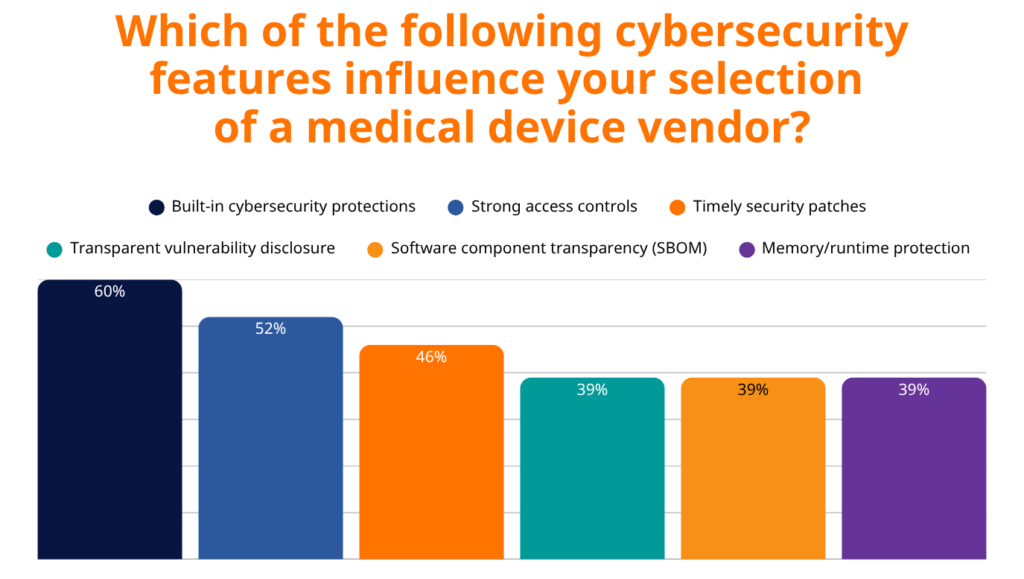
60% of healthcare organizations prioritize built-in cybersecurity protections when selecting vendors. This preference reflects hard-learned lessons where retrofitted security measures proved insufficient against sophisticated attacks.
Runtime protection technologies are gaining traction, with 36% of organizations actively seeking devices with these capabilities, while another 38% are aware of these technologies but don’t yet require them. This suggests the market is evolving rapidly from early adoption to mainstream expectation.
3. Premium Pricing for Premium Protection
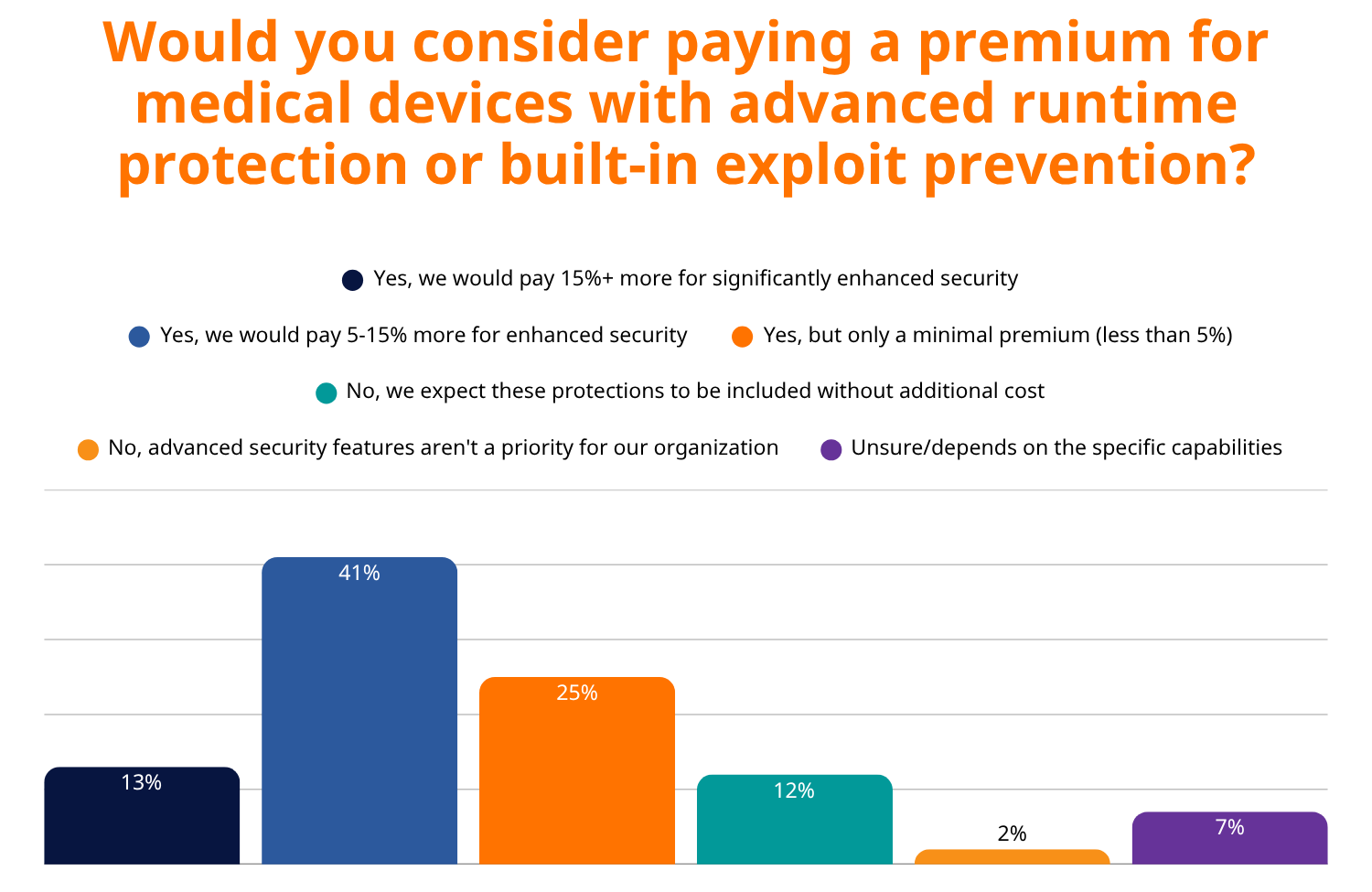
Perhaps most telling is healthcare buyers’ willingness to invest in advanced security. 79% of buyers would pay a premium for devices with advanced runtime protection, with 41% willing to pay up to 15% more for enhanced security.
This demonstrates that healthcare leaders have moved beyond viewing cybersecurity as a checkbox requirement to understanding it as a complex, resource-intensive discipline that requires ongoing investment. They recognize the documented financial impact of attacks like WannaCry, which cost the NHS £92 million, and understand that prevention is far more cost-effective than recovery.
The Regulatory Landscape Is Amplifying Demands
73% of healthcare organizations report that new FDA cybersecurity guidance and EU regulations are already influencing their procurement decisions. The regulatory environment is creating a cascading effect where compliance requirements drive purchasing behavior, making cybersecurity not just a competitive advantage but a regulatory necessity for market access.
Key regulatory drivers include:
- FDA’s Section 524B mandates cybersecurity information in submissions for network-capable devices
- The EU’s Cyber Resilience Act imposes mandatory cybersecurity requirements on connected products
- The NIS2 Directive explicitly targets medical device manufacturers with cybersecurity compliance requirements
The Financial Reality: Budgets Are Rising, Confidence Is Lagging
Healthcare organizations are responding with their wallets—75% increased their medical device and OT security budgets over the past 12 months. However, only 17% feel extremely confident in their ability to detect and contain attacks on medical devices.
This gap between spending and confidence suggests that simply throwing money at the problem isn’t enough. It highlights the critical need for solutions that work within the unique constraints of medical devices that often can’t be easily patched, may run on legacy operating systems, and require 24/7 availability for patient care.
What This Means for Medical Device Manufacturers
The transformation of healthcare cybersecurity expectations presents both opportunities and imperatives for manufacturers:
Opportunities:
- Economic foundation for security innovation: With buyers willing to pay premium prices, manufacturers now have the financial justification to invest heavily in security features
- Competitive differentiation: Manufacturers who embrace transparency and built-in security can capture market share from competitors who lag behind
- Regulatory compliance as market access: Meeting new cybersecurity requirements extends beyond avoiding penalties to gaining access to buyers who will not consider non-compliant products
Imperatives:
- Secure by Design: Retrofitting security is no longer acceptable; it must be integrated from the ground up
- Transparency through SBOMs: Accurate, comprehensive Software Bills of Materials are becoming table stakes
- Runtime protection: Advanced security features like runtime exploit prevention are rapidly moving from nice-to-have to must-have
- Ongoing vulnerability management: Manufacturers must demonstrate proactive approaches to identifying and addressing security issues
The Path Forward: Prevention Over Reaction
The data in the 2025 Index makes it clear that healthcare is moving from reactive cybersecurity to proactive prevention. The organizations that have experienced attacks understand that the most sophisticated incident response plan is no substitute for preventing the attack in the first place.
The healthcare industry is essentially conducting risk-based purchasing decisions, weighing the cost of advanced security features against the potential catastrophic consequences of device vulnerabilities. And increasingly, they’re concluding that the cost of prevention is far lower than the cost of compromise.
For medical device manufacturers, this transformation represents a fundamental shift in market dynamics. Those who embrace security transparency, integrate runtime protections, and demonstrate proactive vulnerability management will find themselves positioned to capture market share in an industry increasingly willing to invest in advanced protection.
Conversely, manufacturers who treat cybersecurity as an afterthought risk not only regulatory rejection but also exclusion from a market that has fundamentally redefined what constitutes an acceptable medical device.
The convergence of IT and OT security, combined with unprecedented regulatory oversight and buyer sophistication, has created a new competitive landscape where cybersecurity excellence serves as the foundation upon which trust, market access, and patient safety are built.
Key Takeaways for Medical Device Manufacturers
- Cybersecurity is now a gatekeeper to market access—nearly half of healthcare buyers will reject products over security concerns
- Built-in security trumps bolt-on solutions—60% of buyers prioritize integrated cybersecurity protections
- Transparency through SBOMs is non-negotiable—78% consider them essential or important in procurement decisions
- Premium pricing is acceptable for premium protection—79% of buyers will pay more for advanced security features
- Regulatory compliance drives purchasing behavior—73% report that new cybersecurity guidance influences procurement decisions
The message from healthcare leaders is clear: security isn’t negotiable anymore. It’s the price of admission to a market.
Download the full 2025 Medical Device Cybersecurity Index for all the key takeaways and findings.
Learn more about how RunSafe Security helps medical device manufacturers integrate security with our Protect solution and unique SBOM generator.
The post What Healthcare Buyers Expect from Medical Device Manufacturers: Security Is No Longer Negotiable appeared first on RunSafe Security.
]]>The post The EU Cyber Resilience Act (CRA) Exposed: What You Need to Know Now appeared first on RunSafe Security.
]]>
What Is the CRA and Who Does It Affect?
The EU Cyber Resilience Act originated from a European Commission proposal in 2022, underwent extensive review, and was approved in March 2024. The Act was published in November 2024, with phased requirements beginning in September 2026 (notably, incident and vulnerability reporting) and full compliance—including Software Bill of Materials (SBOM) mandates—by December 2027.
If you manufacture or sell cyber-enabled devices in the EU—think everything from baby monitors to smartwatches—you are likely subject to the CRA. There are some exceptions for industries already tightly regulated, such as automotive and aviation, but for most hardware and software products with digital components, the EU CRA will apply.
The Act is designed to address the growing security and privacy risks of connected devices, emphasizing not just critical infrastructure but also everyday consumer products.
Key Provisions: Lifecycle Security and SBOMs
One of the most significant aspects of the Cyber Resilience Act is its requirement for a “Secure by Design” approach. This means organizations must plan for, design, develop, and maintain secure products from inception through end-of-life. Security is no longer an afterthought, but must be embedded throughout the entire product lifecycle.
A central pillar of compliance is the Software Bill of Materials (SBOM). Much like a list of ingredients on food packaging, an SBOM details every component—especially third-party and open-source code—within a product. This transparency is crucial for identifying vulnerabilities and managing risk across complex supply chains.
“Software Bill of Materials is actually an essential point to help share across the ecosystem, across the value chain. It’s a new journey to elevate your security posture even higher by really knowing exactly what’s in all those components in your final product.” — Joseph M. Saunders
New Liabilities and the Cost of Non-Compliance
The CRA introduces substantial new liabilities for non-compliance, including fines of up to €10 million or 2.5% of global turnover. These penalties aim to ensure organizations take cybersecurity seriously. While some may view this as a burden, Saunders argues these “sticks” are necessary to promote best practices, improve code quality, and enhance organizational resilience.
How Are Organizations Preparing?
Forward-looking companies are already taking action to align with EU CRA requirements:
- Cross-functional planning: Security is being embedded across legal, development, marketing, and product teams.
- SBOM adoption: Organizations are building workflows to generate and update SBOMs throughout the lifecycle.
- Supply chain scrutiny: Greater transparency is being demanded from vendors and partners.
- Incident response readiness: Detection, reporting, and remediation capabilities are being strengthened.
The Role of Cyber Insurance in a Post-CRA World
Even with the best Secure by Design development practices in place, vulnerabilities will still surface. No software is flawless, and the complexity of modern digital ecosystems—particularly those reliant on third-party and open-source components—means that gaps in security are nearly unavoidable.
The EU Cyber Resilience Act (CRA) raises the stakes, holding manufacturers and developers accountable for the entire lifecycle of their products. This makes cyber insurance not just a smart investment but a strategic imperative.
“Cyber insurance for products is a great idea,” Saunders said, explaining how you can set up engineering processes to follow certain steps to reduce risk. If you can demonstrate that you are taking steps to avoid an attack, then an insurer can provide coverage.
As compliance obligations expand and the consequences of non-conformance grow more serious, organizations need robust risk transfer mechanisms to safeguard against the financial fallout of cyber incidents and regulatory breaches.
In the post-CRA environment, insurers may begin requiring evidence of strong cybersecurity hygiene—such as regular vulnerability assessments, real-time monitoring, SBOM documentation, and incident response readiness—as prerequisites for coverage or lower premiums. By combining proactive security practices with the safety net of cyber insurance, companies can create a more resilient posture while minimizing exposure to emerging risks.
Preparing to Compete in the Cyber Resilience Economy
The EU CRA signals a fundamental shift in how security is expected to be built, managed, and demonstrated across connected products. It’s a wake-up call for organizations that have deprioritized security in favor of speed or cost savings.
By embracing Secure by Design principles, adopting Software Bill of Materials (SBOM) practices, and building security into every stage of the product lifecycle, forward-thinking organizations can prepare for regulatory compliance and gain a competitive edge. These efforts increase stakeholder trust, improve software quality, and reduce time-to-remediate when issues arise.
Rather than viewing the CRA as a burden, it should be seen as a blueprint for building trust in the digital age. Organizations that act now will not only avoid fines and reputational damage, they’ll also be better positioned to lead in a marketplace that increasingly rewards transparency, security, and resilience.
The post The EU Cyber Resilience Act (CRA) Exposed: What You Need to Know Now appeared first on RunSafe Security.
]]>The post A Guide to SBOM Requirements Around the Globe appeared first on RunSafe Security.
]]>Over the past several years, regulators around the globe have begun issuing Software Bill of Materials (SBOM) requirements and standards in an effort to strengthen software security. SBOMs are a detailed inventory of all the components—open source, proprietary, and third-party—used in a software application. SBOMs provide visibility into software components and are a valuable tool for strengthening software supply chain security and traceability. Why are regulators focusing on SBOMs now, and what does that mean for your software development practices? This guide will take a look at SBOM requirements around the globe, their origins, and emerging global trends. Whether you’re a software developer or part of a security-focused team, staying updated on SBOM regulations is critical for compliance and safeguarding your software ecosystem.
Why SBOMs Are Becoming a Must-Have
SBOM requirements didn’t emerge in a vacuum. They were born in response to two major software supply chain attacks, the most infamous of which was the SolarWinds attack of 2020.
1. The SolarWinds Attack of 2020
The SolarWinds attack marked a turning point in cybersecurity history. This sophisticated supply chain compromise impacted over 18,000 organizations, including multiple U.S. federal agencies. Attackers leveraged vulnerabilities in SolarWinds’ software updates to gain unauthorized access, demonstrating how a lack of visibility into source components could have devastating consequences. The fallout from this attack placed a spotlight on SBOMs as a tool to identify and mitigate risks in software supply chains. By providing detailed inventories of software components, SBOMs have since emerged as a foundational element of secure software development practices.
2. The Log4Shell Vulnerability
Another major wake-up call came in late 2021 with the discovery of the Log4Shell vulnerability. This critical flaw in the widely-used Log4j library exposed organizations worldwide to potential exploitation. Many companies scrambled to assess their exposure, yet their lack of comprehensive SBOMs caused unnecessary delays in response times. These incidents collectively underscored the critical importance of having a full inventory of software dependencies to identify vulnerabilities quickly and ensure timely remediation.

The Evolution from Request to Requirement
Executive Order 14028 (2021)
Following the SolarWinds attack, the White House issued Executive Order (EO) 14028 on Improving America’s Cybersecurity in 2021. The EO required federal agencies to request SBOMs from software vendors. The National Telecommunications and Information Administration (NTIA) outlined the “Minimum Elements for an SBOM,” which include:
- Data fields (component name, version, supplier)
- Automation support for machine-readable formats
- Practices for SBOM updates and distribution
The mandate brought awareness to the necessity of SBOMs, but lacked strong enforcement mechanisms, serving as a framework for how to enforce SBOMs in the future.
CISA Guidance (2024)
In 2024, the The Cybersecurity and Infrastructure Security Agency (CISA) expanded on the original guidance from the NTIA, issuing the framework: “Framing Software Component Transparency: Establishing a Common Software Bill of Materials (SBOM).” The CISA framing document is the most up-to-date guidance for how to build an SBOM, including direction on what to include in an SBOM and processes for SBOM creation and exchange. While the CISA guidance is not an enforcement directive, these recommendations have transformed into hardline requirements enforced by specific federal agencies, which we review below.
Key U.S. SBOM Requirements Today
FDA Cybersecurity in Medical Devices Requirements (2023)
In 2023, the FDA updated their guidance on “Cybersecurity in Medical Devices.” The FDA now requires medical device manufacturers to submit SBOMs during premarket reviews for “cyber devices” that connect to the internet or are sensitive to cybersecurity risks. These SBOMs must include:
- Lifecycle information
- Vulnerability assessments
- Remediation plans
U.S. Army SBOM Directive (2024)
The U.S. Army SBOM Directive was released on August 16, 2024 and the SBOM requirements will take effect in February 2025. This directive was issued in the form of a memo detailing the Army’s strategy to mandate the inclusion of SBOMs in most new software contracts. Software contractors and subcontractors will need to supply SBOMs for nearly all software-related contracts, including commercial off-the-shelf (COTS) products.
PCI DSS 4.0 Standards (2024)
PCI DSS 4.0 governs payment card data security and encourages SBOM usage among payment processing software providers.
SBOM Compliance Requirements Around the Globe
1. The European Union
In 2024, the EU adopted the Cyber Resilience Act (CRA), a landmark regulation designed to ensure that hardware and software products with digital elements are secure before they are placed on the market. Under the CRA, manufacturers need to identify, address, and report on vulnerabilities within their products, including mandatory SBOM generation. The CRA covers a range of connected devices, from cameras and appliances within our homes to hardware and software deployed within critical infrastructure.
2. Germany
In 2023, Germany’s Federal Office of Information Security (BSI) adopted Technical Guideline TR-03183 on Cyber Resilience Requirements for Manufacturers and Products. TR-03183 provides detailed requirements for SBOMs with the goal of preparing manufacturers ahead of the upcoming enforcement of the CRA. The guideline specifies minimum fields of information and preferred formats for SBOMs, mirroring the standards set by the U.S. National Telecommunications and Information Administration (NTIA).
3. The United Kingdom
The UK’s National Cyber Security Centre (NCSC) encourages organizations to adopt SBOMs as part of their cybersecurity best practices. While not yet mandatory, NCSC has issued guidelines advocating for SBOMs to improve transparency and mitigate risks in software systems.
4. Australia
The Australian Cyber Security Centre (ACSC) has become a vocal proponent of SBOMs to enhance software supply chain security. Through comprehensive frameworks and recommendations, the ACSC encourages organizations to leverage SBOMs as a key defense mechanism against vulnerabilities.
5. Japan
Recognizing the global move toward SBOM adoption, Japan has launched proof-of-concept projects in collaboration with private industry players. The government plans widespread implementation by 2025, ensuring businesses have time to adapt.
Industry-Specific SBOM Requirements
Various industries face unique SBOM requirements to address specific challenges.
- Healthcare: The FDA mandates thorough SBOMs given the critical implications of the breach of a medical device for patient health and safety.
- Government Contractors: Compliance with Executive Order 14028 is essential for businesses working with federal agencies.
- Critical Infrastructure: CISA guidance is paving the way for SBOM adoption in critical infrastructure like energy and transportation.
- Automotive: Software-driven cars rely heavily on SBOMs to ensure compliance and enhance consumer safety.
What These SBOM Standards Mean for Organizations
The global push for SBOMs reflects a shared understanding of their importance in reducing risk in the software supply chain. While requirements vary in scope, organizations across industries must prepare to align with emerging regulations. Here’s how SBOMs provide real, functional value to businesses worldwide:
1. Improved Security
By tracking software dependencies and components, SBOMs enable organizations to promptly identify and remediate vulnerabilities like Log4Shell or Heartbleed.
2. Simplified Compliance
Legal mandates such as the FDA Cyber Device Rule or the EU CRA mean SBOMs are increasingly non-negotiable for regulatory compliance. Enterprises that embed SBOM practices into their workflows are better equipped for compliance.
3. Enhanced Transparency
SBOMs foster trust between vendors and customers by offering a detailed view of software components. This transparency can serve as a competitive advantage in an increasingly security-conscious market.
4. Proactive Risk Management
SBOMs empower organizations to adopt a proactive approach to software security. By continuously monitoring and updating software inventories, businesses can stay ahead of risks.

Preparing for Compliance
Adopting SBOMs involves several best practices to ensure proper implementation and alignment with regulatory requirements.
Steps to Get Started
- Inventory Existing Software: Conduct a thorough review of existing software to identify components and dependencies.
- Select an SBOM Tool: Choose from industry-leading SBOM generation tools. Look for solutions that support multiple formats, such as SPDX and CycloneDX, as these are commonly recommended by global standards.
- Update Security Policies: Incorporate SBOMs into your organization’s software development lifecycle and establish policies for ongoing updates.
- Train Your Team: Ensure your development and security teams understand how to generate and manage SBOMs effectively.
- Collaborate with Vendors: Require third-party vendors to provide SBOMs as part of contract negotiations.
Businesses that take proactive steps to integrate SBOM practices can better secure their software supply chains while meeting compliance deadlines.
Building the Future of Secure Software
Much like the cybersecurity landscape itself, SBOM regulations are in a state of rapid evolution. Businesses that remain proactive, informed, and adaptive stand to gain the most from this shift toward transparency and accountability.
The post A Guide to SBOM Requirements Around the Globe appeared first on RunSafe Security.
]]>The post Is Regulatory Harmonization on the Horizon? The Medical Devices Cybersecurity Landscape in the EU and the US appeared first on RunSafe Security.
]]>RunSafe Security and Critical Software are partners in delivering comprehensive safety and security solutions for critical sectors in Europe and the US.
Imagine modern healthcare services without medical devices. You can’t? Neither can we. Medical devices perform a vital role in the patient experience, from diagnosis to treatment to follow-up. Advances in tech have enhanced these devices and, in turn, have improved patient outcomes. Personalized treatment plans using data gathered from wearables; real-time monitoring of patients’ conditions allowing healthcare professionals to intervene in a timely fashion; AI-powered surgical systems assisting surgeons during complex operations – all of these have revolutionized the way patients are treated.
But they have also widened the threat horizon for patients. The ever-increasing range of cyber threats pose serious reputational risks to manufacturers and could mean the difference between life and death for patients. But to combat these threats, different jurisdictions have implemented their own medical device cybersecurity standards, creating friction for manufacturers operating in various markets.
From the European Union’s Medical Devices Regulation (MDR) to the United States’ Foods & Drug Administration (FDA), medical device manufacturers need to ensure their devices comply with cybersecurity standards outlined in each jurisdiction. But is this getting easier or more complex in an ever-more complex threat environment?
Medical Device Cybersecurity in the EU
The EU’s MDR outlines clear rules with which medical device manufacturers must comply in the domain of cybersecurity, particularly with regards to following risk management practices aligned with ISO 31010 and ISO 14971.
Post-market surveillance is critical to this: the manufacturer is responsible for keeping track of any cybersecurity vulnerabilities that present themselves in their devices and must work to rectify these once identified.

Harmonization of Medical Device Standards and Regulations
Yet harmonization is already occurring between the two regulators, reducing friction and making manufacturers’ lives easier. ISO 13485 is adhered to by both the MDR within the EU and the US FDA, aligning quality management system regulations between the two markets. This is in addition to the most recent update of harmonized standards made by the EU in March 2024, this being the next step in the bloc’s efforts to align its standards with those applicable globally.
The International Medical Devices Regulators Forum (IMDRF) plays a role in reducing barriers for manufacturers operating in the EU and US, with shared guidance on clinical evaluation and post-market surveillance making it easier for manufacturers to distribute, monitor, and “sense-check” their devices, ensuring compliance with a harmonized set of standards. This is integral in the cybersecurity domain, ensuring protection against evolving threats in whichever market the devices are placed in.
What Does This Mean for Cybersecurity?
Both the EU’s MDR and the FDA’s regulations require a risk-based approach, ensuring that residual risks are assessed and managed throughout the device’s lifecycle. In terms of cybersecurity, this demands extensive risk management documentation. Similarly, Secure by Design has been implemented in both the EU and the US: the MDR encourages manufacturers to implement cybersecurity measures from the earliest stage of the design process, while the FDA requires Secure Product Development Frameworks (SPDFs) be followed from early design to product release.
There is still much work to do, however. Since 2010, the number of cybersecurity incidents in the EU and the US has increased. From 2021 to 2023, there were over 215 publicly reported cybersecurity incidents relating to medical devices in the EU. In the US, it is estimated that over 53% of devices on the market possess critical cyber vulnerabilities. A 2024 report from Censys found that there are “14,004 unique IP addresses exposing healthcare devices and data systems connected to potentially sensitive medical information on the public internet. These exposures greatly raise the risk of unauthorized access and exploitation.”

The Future of Cybersecurity Regulatory Alignment
Regulatory alignment is heading in the right direction, but as we have seen, there is still more work to be done. While harmonization is progressing, critical vulnerabilities remain in copious amounts of medical devices and healthcare products in the market, which opportunistic hackers and hostile actors can take advantage of.
Want to discover more about the pivotal role of cybersecurity in medical devices? Catch up with Critical Software and RunSafe Security’s recent webinar featuring Afonso Neto from Critical Software and Doug Britton from RunSafe Security, who outlined some of the most pressing cybersecurity aspects underpinning medical device regulations in the EU and USA. Watch the webinar here.
The post Is Regulatory Harmonization on the Horizon? The Medical Devices Cybersecurity Landscape in the EU and the US appeared first on RunSafe Security.
]]>The post RunSafe Security’s 2025 Product Security Predictions appeared first on RunSafe Security.
]]>As we move forward into 2025, this focus is extremely promising for the future. We see change all around us and uncertainty in every arena. However, forward momentum is what we need to build more resilient products that can stand the test of time.
Looking ahead, here are five predictions on how product security will evolve in 2025.
View the five predictions as an infographic here.
1. 200 More Companies Will Pledge Their Commitment to Secure by Design
As of December 2024, 256 companies have already signed CISA’s Secure by Design pledge, including companies like Cisco, IBM, Google, and Microsoft. RunSafe Security has also signed the pledge, which includes seven goals for software manufacturers to work toward to improve the security of their products.
Secure by Design will certainly shape the future of product security and development for decades to come. We’re already seeing the effects with notable signees detailing their progress toward the pledge goals. Overall, Secure by Design will continue to encourage software manufacturers to focus on areas like software supply chain security and memory safety to reduce the risks to and attack surface of embedded devices. As we at RunSafe emphasize, we want to reshape the economics of security to favor defenders. Secure by Design helps to make this possible by focusing on security from the earliest stages of design and development, and we believe hundreds more companies will take up the challenge in the year ahead.
2. Asset Owners Will Begin to Demand Secure by Design
Product security is on the minds of manufacturers, but what about the buyers of software who deploy these products within their organizations and across critical infrastructure?
As we look ahead to next year, software buyers will begin to get curious about their software supply chain and the steps their vendors are taking to reduce risk within their products. As part of this, asset owners should ask suppliers to provide Software Bill of Materials (SBOMs) to gain insight into potential exposures and vulnerabilities within software across asset owner infrastructure.
One example of an area for asset owners to focus on is CISA’s Roadmap to Memory Safety, which urges software manufacturers to publish a memory safety roadmap by January 1, 2026. Asset owners can use the memory safety roadmap as a starting point to talk with suppliers and discuss how they will approach eliminating this class of vulnerabilities.

3. Product Liability Will Come Into Focus
While Secure by Design and other CISA guidance is voluntary, as more organizations adopt these principles, there is a strong possibility that approaches to product liability and cyber insurance within the software industry will begin to shift. Though it would be surprising to see a new executive order on critical infrastructure and product liability issued in 2025, we are seeing an immediate response to the EU Cyber Resilience Act. Perhaps the market will seek to increase cybersecurity warranties, guarantees, and insurance.
As software manufacturers take on more of the security burden, the way liability is distributed between suppliers and their customers in the event of a security incident will change. Device manufacturers will need to consider what the liability shift means for their business and adopt a new financial perspective to address downside liability.
4. Software Manufacturers Will Prioritize Immediate Solutions for Memory Safety
A key aspect of Secure by Design guidance issued by CISA is memory safety, and it plays a critical role in the overall security of embedded devices. Yet for many, memory safety is not as achievable by simply rewriting products..
Going into 2025, we expect an alternative to memory safe languages to enter more prominently into the product security discussion. Although Secure by Design guides device manufacturers to rewrite all of their C and C++ software into a memory safe language like Rust, doing so would take decades and require a significant expenditure of resources and human power to accomplish. For companies who produce dozens or hundreds or even thousands of embedded software products deployed across critical infrastructure (often with 10-30 year lifespans), it is neither feasible nor practical for them to simply rewrite all their products in memory safe languages. Not doing so, however, leaves the door open for attack in the near term.
For this reason, it’s important that software manufacturers insert memory protections, such as load-time function randomization, intoexisting devices today rather than wait the time it would take to rewrite code. Commercial solutions, like RunSafe’s Protect solution, already exist to provide immediate protection and prevent the exploitation of devastating memory safety vulnerabilities.

5. Companies Will Become More Transparent in Sharing SBOMs
High-profile software supply chain attacks like SolarWinds and Log4j spurred the need for organizations to have visibility into their software components. SBOMs emerged as a tool for managing and mitigating software supply chain risks.
For companies that are committed to Secure by Design and product security best practices, we believe there is great value in publicly sharing SBOMs or sharing SBOMs between asset owners and suppliers. Doing so signals honesty and transparency in software development practices and makes it easier to understand where potential vulnerabilities lie.
Advancing the Resilience of Software in the Year Ahead
2025 is shaping up to be a big year for product security and the implementation of Secure by Design. We can be certain that nation-states, adversaries, and APTs will continue to target the software supply chain. I remain optimistic that software manufactures, software buyers, and the cybersecurity industry on the whole can work together to advance the resilience of software deployed in embedded devices to safeguard critical infrastructure and our world.
Learn more about best practices for safeguarding code. Download our guide to get the knowledge and tools you need to address memory safety challenges and protect your code today and into the future.
The post RunSafe Security’s 2025 Product Security Predictions appeared first on RunSafe Security.
]]>The post CISA’s 2026 Memory Safety Deadline: What OT Leaders Need to Know Now appeared first on RunSafe Security.
]]>It’s for this reason, among other national security, economic, and public health concerns, that the Cybersecurity and Infrastructure Security Agency (CISA) has made memory safety a key focus of its Secure by Design initiatives.
Now, CISA is urging software manufacturers to publish a memory safety roadmap by January 1, 2026, outlining how they will eliminate memory safety vulnerabilities in code, either by using memory safe languages or implementing hardware capabilities that prevent memory safety vulnerabilities.
Though manufacturers are on the hook for the security of their products, the responsibility doesn’t fall solely on the shoulders of the manufacturers. Buyers of software in the OT sector also have an equally important role to play in addressing memory safety to build the resilience of their mission-critical OT systems against attack.
“The roadmap to memory safety is a great starting point for asset owners to talk to their suppliers, saying this is a big concern of mine, especially for my OT software,” said Joseph M. Saunders, Founder and CEO of RunSafe Security. “Then, what we’re looking for from product manufacturers is that they have a mature process to assess how to achieve memory safety.”
Why Memory Safety Should Be on Your Radar
Why all the fuss about memory safety, and why now? Memory safety vulnerabilities consistently rank among the most dangerous software weaknesses, and they are alarmingly common. Within industrial control systems, memory safety vulnerabilities have been steadily rising, growing from less than 1,000 CVEs in 2014 to nearing 3,000 in 2023 alone.
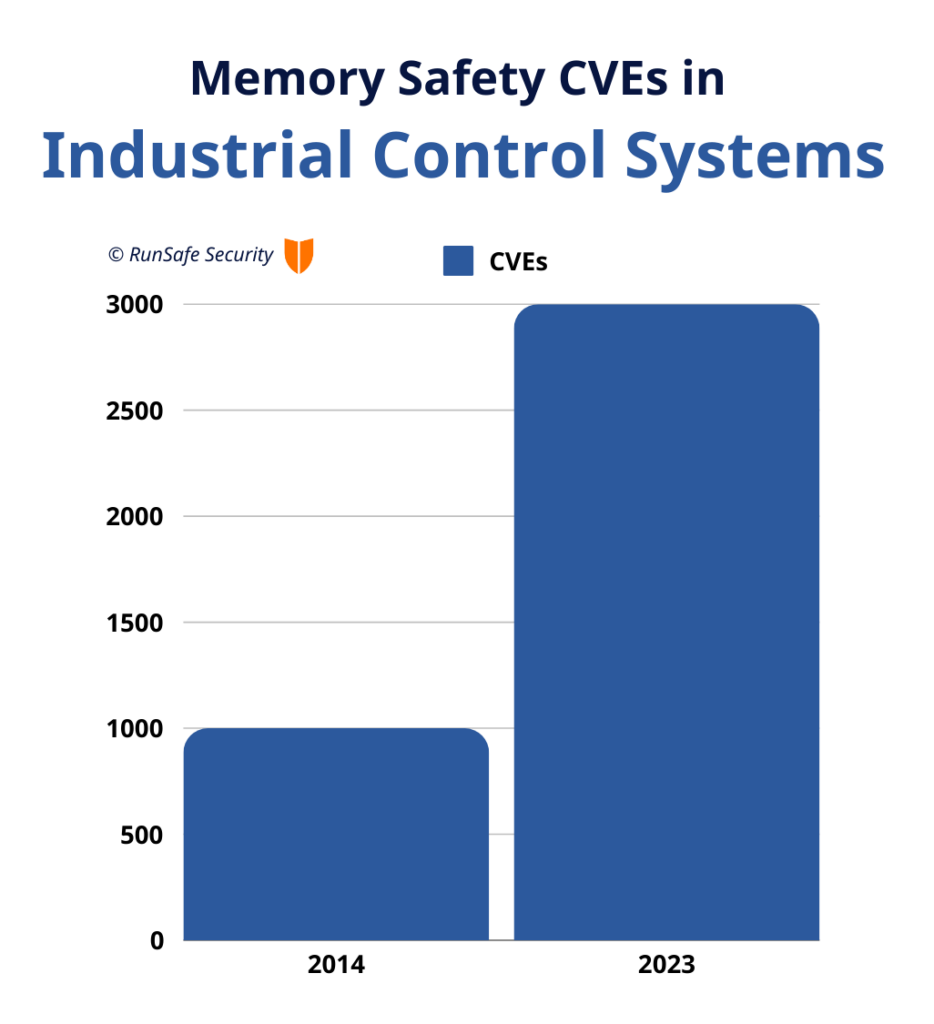
In one example, programmable logic controllers were found vulnerable to memory corruption flaws that could enable remote code execution. In the OT world, where systems control critical industrial processes, such vulnerabilities aren’t just security risks — they’re potential catastrophes waiting to happen.

Building a Memory Safety Strategy: Collaboration Between OT Software Manufacturers and Buyers Is Needed
CISA has set a clear deadline: January 1, 2026. With this date in mind, OT software manufacturers and buyers can begin to have important conversations about addressing memory safety, both for existing products written in memory-unsafe languages and for new products to be released down the line.
What should be on the agenda for discussion when building and evaluating a memory safety roadmap? Here are four key areas to look at.
1. Vulnerability Assessments
Start with a comprehensive Software Bill of Materials (SBOM) to identify and prioritize memory-based vulnerabilities in OT software. Think of it as a detailed inventory that helps you:
- Identify existing vulnerabilities
- Map your software supply chain
- Pinpoint products most at risk from memory-based vulnerabilities
2. Smart Remediation Planning
Once vulnerabilities are identified, manufacturers should take next steps to eliminate them. OT software buyers can discuss with manufacturers about remediation options like:
- Prioritizing addressing systems with high exposure and potential impact
- Evaluating options for rewriting legacy code in memory-safe languages, like Rust
- Considering proactive solutions such as Load-time Function Randomization (LFR) for existing systems when code rewrites are not practical
3. Future-Proofing Your Products
Software buyers should discuss with their suppliers how they are incorporating memory safety into their product lifecycle planning.
Look ahead by:
- Integrating memory safety into your product roadmap
- Taking advantage of major architectural changes to implement memory-safe languages
- Deploying software memory protection for existing code
4. Building Strong Partnerships
A memory safety roadmap is a great opportunity for software manufacturers and buyers to open up conversations about memory safety and collaborate to find a path forward. When considering working with a supplier, evaluate their willingness to
- Establish regular communication channels
- Transparently track progress
- Demonstrate a shared commitment to security goals
Moving Forward with CISA’s Memory Safety Guidance
By working together, software buyers and manufacturers can not only meet CISA’s memory safety mandate but also build more resilient OT systems.
“All asset owners should do a study with their suppliers to understand the extent to which they are exposed to memory safety vulnerabilities,” Saunders said.
From there, software manufacturers can build a roadmap to tackle the memory safety challenge once and for all.
Learn more about how RunSafe Security protects critical infrastructure and OT systems from memory-based vulnerabilities.
The post CISA’s 2026 Memory Safety Deadline: What OT Leaders Need to Know Now appeared first on RunSafe Security.
]]>The post Buckle Up: Addressing Embedded Systems Security in the Automotive Software Supply Chain appeared first on RunSafe Security.
]]>
If you’ve made a recent trip to San Francisco, it can feel like you’ve stepped into the future when you spot an autonomous vehicle navigating the streets, picking up passengers, and cruising the city’s famous hills. But as autonomous vehicles move from concept to reality and vehicle connectivity becomes the norm, embedded systems, the technology that makes it all possible, are an often overlooked but critical piece of automotive security.
Citing national security concerns, the Biden Administration proposed two bans in September 2024 that draw attention to the software supply chain within the automotive industry and the potential risks of autonomous and connected vehicles. Because modern cars include microphones, cameras, GPS tracking, and more, there is a very real threat that nation-state actors could exploit software to conduct surveillance, collecting data on vehicle movements, for example. Further, it’s possible that a bad actor could gain access through a software backdoor and disable an entire fleet of vehicles at one time, posing an immediate risk to drivers and disrupting society.
The bans, if approved, seek to address this, first by prohibiting new vehicle software originating within China or Russia by 2027 and second banning the imports and sales of vehicles with automated driving hardware created in the countries to go into effect by 2030.
While the implications of the bans and others like it will shake out in the years ahead, the reality for today is that we need solutions that will keep autonomous and connected vehicle software resilient and secure against known threats and those yet to come.
Why Embedded Systems Matter for Automotive Security
Embedded systems are integral to modern vehicles, processing sensor data and controlling everything from engine performance to collision avoidance. However, as vehicles become more connected and automated, embedded systems face mounting security challenges and are vulnerable to a range of threats, including unauthorized access, data breaches, and potential manipulation of vehicle controls.
“The automobile is becoming more and more of a computer on wheels and, in addition, it’s connected to a lot of different things,” explained Dave Salwen, VP of Embedded Systems at RunSafe. “While its use is great for the consumer with new features and new capabilities, it’s becoming more and more software-centric. More software vulnerabilities are coming into the system and more vulnerabilities can be exploited by bad actors.”
One of the biggest threats to embedded systems is memory-based vulnerabilities. Memory safety is a foundational aspect of software development, ensuring that programs operate reliably and securely without accessing or manipulating memory incorrectly.
Vehicle software is vulnerable to memory safety threats in four key systems:
-
- Electronic Control Units (ECUs) in Autonomous Vehicles: Responsible for critical driving functions (e.g., braking, acceleration, steering). A buffer overflow attack could lead to unauthorized access and control and erratic vehicle behavior.
- In-Vehicle Infotainment Systems (IVI): Infotainment systems need to be safeguarded from heap-based overflow vulnerabilities, which could be exploited to execute arbitrary code and gain access to other vehicle systems.
- Advanced Driver Assistance Systems (ADAS): ADAS software needs to be protected from stack-based buffer overflows that could alter sensor data or decision-making algorithms, endangering the vehicle’s safety.
- Connectivity Systems: Connectivity through 4G/5G cellular, bluetooth, wireless CarPlay/Android Auto open the door for memory corruption attacks that can lead to remote access to vehicles.

How to Secure Automotive Embedded Systems and the Software Supply Chain
The need for automotive software supply chain integrity, data security, and automotive safety standards like ISO 26262 and the emerging ISO/SAE 21434 are driving the industry to seek solutions for security and compliance. Here’s where to start.
1. Prioritize Software Bill of Materials (SBOMs) to Evaluate the Software Supply Chain
Software Bill of Materials (SBOMs) are essential tools for demonstrating regulatory compliance, tracking all components, libraries, and modules used in software applications, and enabling quick responses to security concerns. With the proposed bans from the Biden Administration on the horizon, SBOMs will be invaluable for vehicle manufacturers needing to evaluate their software supply chain to ensure they are not incorporating prohibited software. SBOMs provide detailed inventories of software components within a software binary, enabling quick compliance assessments.
2. Secure Embedded Systems from the Ground Up
Secure by Design principles are no longer optional in automotive software development. As vehicles become more complex and interconnected, retrofitting security measures after development is both costly and ineffective. Following Secure by Design principles will include threat modeling during design phases, implementing secure coding practices, conducting regular security testing, and building in mechanisms for secure updates throughout the software lifecycle.
3. Adopt Automated Vulnerability Identification and Advanced Code-Hardening Techniques
Fortifying critical systems against cyber attacks, like braking and steering in an autonomous vehicle, means protecting the millions of lines of code that allow them to function. Automated vulnerability identification and code-hardening protects software against attacks that could compromise vehicle operations and safety while reducing the attack surface.
Specifically, memory relocation techniques prevent memory-based vulnerabilities from being exploited in embedded systems. Known as load-time function randomization, the technique ensures that each instance of the software has a unique memory layout, making it extremely difficult for attackers to predict the location of specific functions, proactively neutralizing common exploit techniques like Return-Oriented Programming (ROP) and buffer overflow attacks.
The Road Ahead: Building Secure and Resilient Vehicles
The increased focus on embedded systems and the automotive software supply chain is a positive one. Ultimately, adopting stronger cybersecurity practices now is an enabler of new vehicle technology, greenlighting innovation and allowing vehicle manufacturers and suppliers to protect their products and customers from the growing landscape of cyber threats.
Learn more about techniques for using SBOM data to track and mitigate security risks in our guide to creating and utilizing SBOMs.
The post Buckle Up: Addressing Embedded Systems Security in the Automotive Software Supply Chain appeared first on RunSafe Security.
]]>The post Elevating Flight Safety: Software Security in Airborne Systems appeared first on RunSafe Security.
]]>Securing Airborne Systems with Advanced Memory Safety Techniques
RunSafe Code Qualification – Development Tool
RunSafe Code Certification – Flight Software
RunSafe Code Certification – Airworthiness Security
Elevating Flight Safety: Software Security in Airborne Systems
Securing Airborne Systems with Advanced Memory Safety Techniques
Critical software, including vital infrastructure management systems, heavily relies on languages like C and C++, notorious for their power but plagued by memory vulnerabilities. The NSA reports that 70% of security fixes by tech giants like Google and Microsoft pertain to memory safety, a concern echoed in MITRE’s Top 25 Most Dangerous Software Weaknesses, where memory safety ranks first, as well as seven of the top twenty-five vulnerabilities.
The crux of the problem lies in the predictability of these languages. Without measures like RunSafe, discovering a memory vulnerability in one software binary becomes a gateway for attackers, simplifying the exploitation process. This challenge is compounded by the proliferation of open-source code and advancing binary analysis tools.
RunSafe’s product, RunSafe Code, aims to address these vulnerabilities. It will be certifiable for flight safety at the highest level through DO-178C at DAL A and qualifiable by DO-330 at TQL 1. Comprising two components, RunSafe Code operates during both compilation and execution of software. The security features of RunSafe will be outlined in shell documents, offering comprehensive insights into its design.
How RunSafe Code Works
RunSafe Code modernizes software security by dynamically relocating function loads into memory uniquely for each instance deployed, thwarting attackers’ attempts to exploit memory-based vulnerabilities, which constitute nearly 70% of compiled code vulnerabilities. This is achieved without altering any lines of source code, ensuring no impact on system performance or functionality.
During the development phase, integrating RunSafe Code into software renders exploitation attempts unreliable for attackers, as the code needed for exploitation is never in the same place twice. Even failed exploit attempts result in program crashes, rendering any gained information useless upon relaunch. This seamless integration with existing compilers and linkers streamlines the development process, ensuring compatibility with various build systems, from simple examples to complex builds using different compilers per project.
In airborne systems, RunSafe Code continues its transformative role, ensuring unique memory layouts for each binary and shared object. Through metadata embedded in the ELF file, RunSafe Code relocates functions in memory using customer-defined seeds, ensuring a deterministic relocation process. Notably, this relocation process incurs no runtime performance overhead, preserving the program’s intended functionality without compromising performance.
This robust approach to software hardening, both during development and deployment, positions RunSafe Code as a vital tool in the arsenal against cyber threats, qualifying it under industry standards such as DO-330 and DO-178C for airborne systems. With RunSafe Code, software developers can confidently bolster their defenses against exploitation attempts, ensuring the resilience and security of critical software systems.

RunSafe Code Qualification – Development Tool
RunSafe is certifying RunSafe Code as a TQL-1 tool and flight software at DAL-A, enabling its use across diverse Critical Software Configuration Items (CSCIs), regardless of their DAL classification. TQL-1, the most stringent level outlined by DO-330, demands meticulous qualification due to its potential impact on flight safety, acknowledging the catastrophic consequences of any defects introduced into flight software.
The certification process adheres rigorously to DO-330’s objectives and activities, ensuring compliance with engineering independence. Recognizing the existing version of RunSafe Code as a prototype, the project anticipates addressing any gaps identified during the certification phase systematically. Development plans, standards, and work products are meticulously crafted and vetted, with engineering independence verifying their integrity.
Moreover, the tool qualification package assembled will furnish CSCI developers with essential materials, including Tool Operational Requirements (TOR), a Tool Qualification Plan (TQP), and verification test cases. Draft materials provided by RunSafe will be tailored by developers, ensuring seamless integration into their environments. Any issues encountered during application will be escalated to RunSafe for resolution, with developers assuming responsibility for correct tool usage and adherence to quality assurance protocols.
RunSafe Code Certification – Flight Software
Under DO-178C, CSCI developers are tasked with creating software that follows a detailed certification plan. RunSafe Code introduces novel alterations to the CSCI executable, invalidating the formal “run for score” test that verifies compliance with DO-178C expectations. Thus, this testing must occur after applying RunSafe Code.
To meet DO-178C requirements, RunSafe Code provides proposed materials for integration into the CSCI developer’s data, including proposed system requirements, Software High Level Requirements (HLRs), and Low Level Requirements (LLRs), along with test cases and trace data. The seed value generated for each load is treated as a Parameter Data Item (PDI) under DO-178C. The qualification package includes draft materials for integration, outlining proposed changes to the CSCI plan and development artifacts to accommodate RunSafe Code alterations.
RunSafe Code modifies source code to relocate itself in allocated memory space upon loading, using a randomly selected seed value. This deterministic relocation ensures uniqueness across instances, thus enhancing software security.
RunSafe Code Certification – Airworthiness Security
DO-326 and DO-356 emphasize an integrated approach to cybersecurity, aiming to prevent and mitigate cyber attacks by integrating security strategies tailored to specific systems and environments. RunSafe Code contributes to this approach by aligning with two key principles: Defense in Depth and Ease of Maintenance.
By enveloping the entire product CSCI with its protective shield, RunSafe forms a crucial layer within the Defense in Depth strategy, allowing developers to concentrate on custom defense strategies for their projects. Moreover, RunSafe Code simplifies CSCI maintenance by assuming responsibility for tool upkeep, training, support, and documentation.
RunSafe provides comprehensive documentation to meet the requirements of DO-326/356, serving as a model for CSCI developers. This documentation includes security certification plans, risk assessments, system requirements, and verification results. While tailored to RunSafe Code, this package serves as a template for other CSCIs, offering operational and maintenance guidance.
Committed to supporting CSCI developers, RunSafe assists in the successful implementation of RunSafe Code and addresses any arising issues, ensuring robust software supply chain security.

The post Elevating Flight Safety: Software Security in Airborne Systems appeared first on RunSafe Security.
]]>